

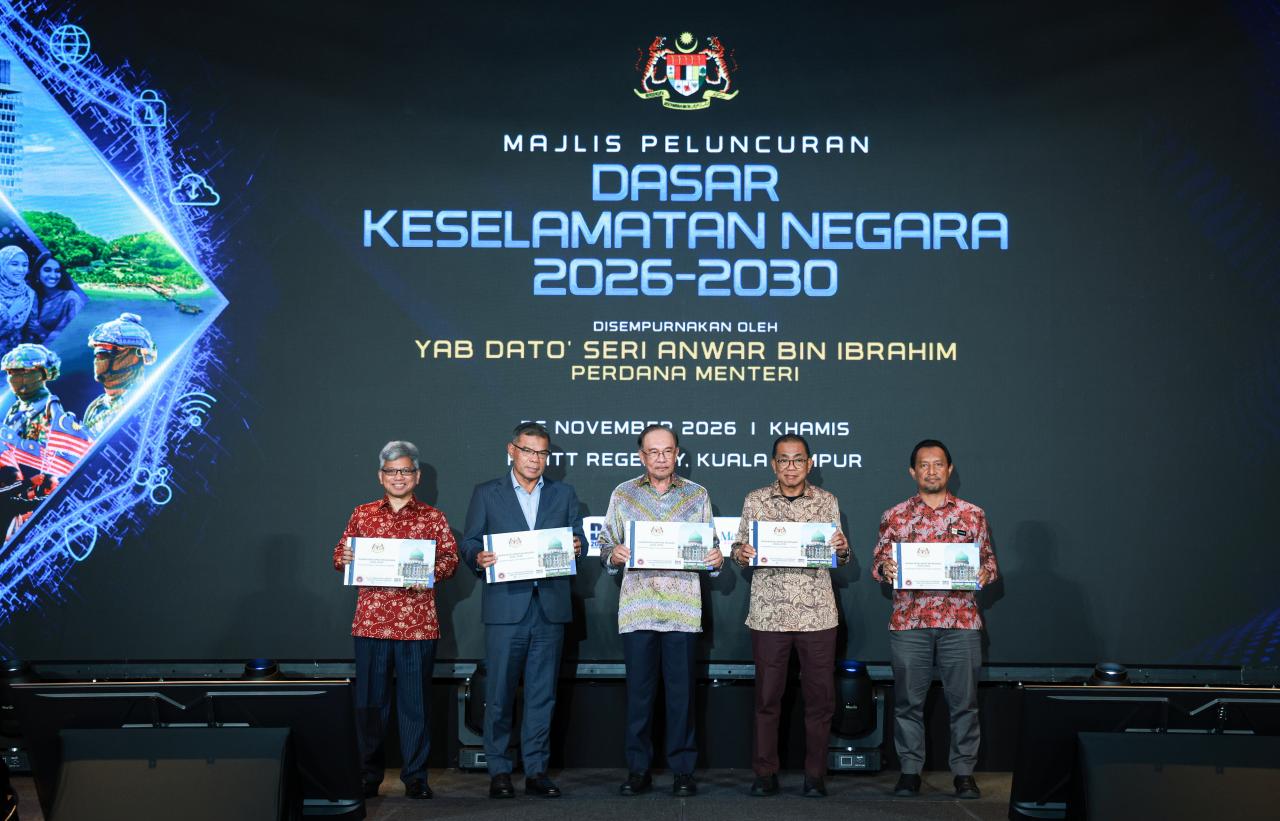
KUALA LUMPUR – Cybersecurity has been identified as a key priority under the National Security Policy (DKN) 2026-2030, as Malaysia moves to strengthen its defences against increasingly sophisticated digital threats.
Prime Minister Datuk Seri Anwar Ibrahim, who launched the policy today, said the evolving security landscape required the country to look beyond conventional military threats and prepare for challenges involving technology, financial systems and critical national institutions, local media reported.
He said cyberattacks could occur thousands, potentially tens of thousands, of times a day, highlighting the need to strengthen the country’s expertise, capabilities and infrastructure to counter such threats.
“National security is no longer just a defence issue discussed by uniformed personnel,” he said at the launch ceremony here.
Anwar said the new policy drew on previous national security frameworks but placed greater emphasis on anticipating emerging threats and responding to challenges that could develop beyond conventional security parameters.
“The national security policy takes into account the perspectives of previous policies, but I believe its strength lies in its ability to anticipate and address new issues and challenges,” he said.
He also cautioned against complacency during peacetime, pointing to historical examples of leaders failing to recognise the scale of looming threats, including Winston Churchill’s initial underestimation of the danger posed by Adolf Hitler.
“I mention this not to frighten us, but to make us more mature,” he said.
The DKN 2026-2030 introduces 10 Strategic Focus Areas, with Cybersecurity and Technology added as a new priority compared with the nine National Security Core Values outlined in the previous policy.
The five-year framework also sets out 30 strategies to address 53 identified security issues, challenges and threats. It introduces a National Security Index (IKK) to assess the country’s security standing and facilitate the early detection of potential risks.
Anwar said national preparedness must also involve strengthening defence assets and improving the welfare of security personnel, including members of the armed forces, police and agencies under the Home Ministry and Defence Ministry.
He stressed that diplomatic engagement with neighbouring countries and cooperation through Asean remained crucial in managing regional security concerns, including tensions in the South China Sea.
He also called for continued improvements to the readiness of the Royal Malaysian Navy.
“The policy is not confined to or limited to security agencies, but must be understood by all civil servants and enforcement officers,” he said.
The DKN 2026-2030 builds on its 2021-2025 predecessor and retains the Comprehensive Security (COMSEC) concept.
Its implementation will be coordinated by the National Security Council (MKN), working with ministries, government agencies, the private sector and the public through a Whole-of-Government and Whole-of-Society approach. – November 26, 2026