

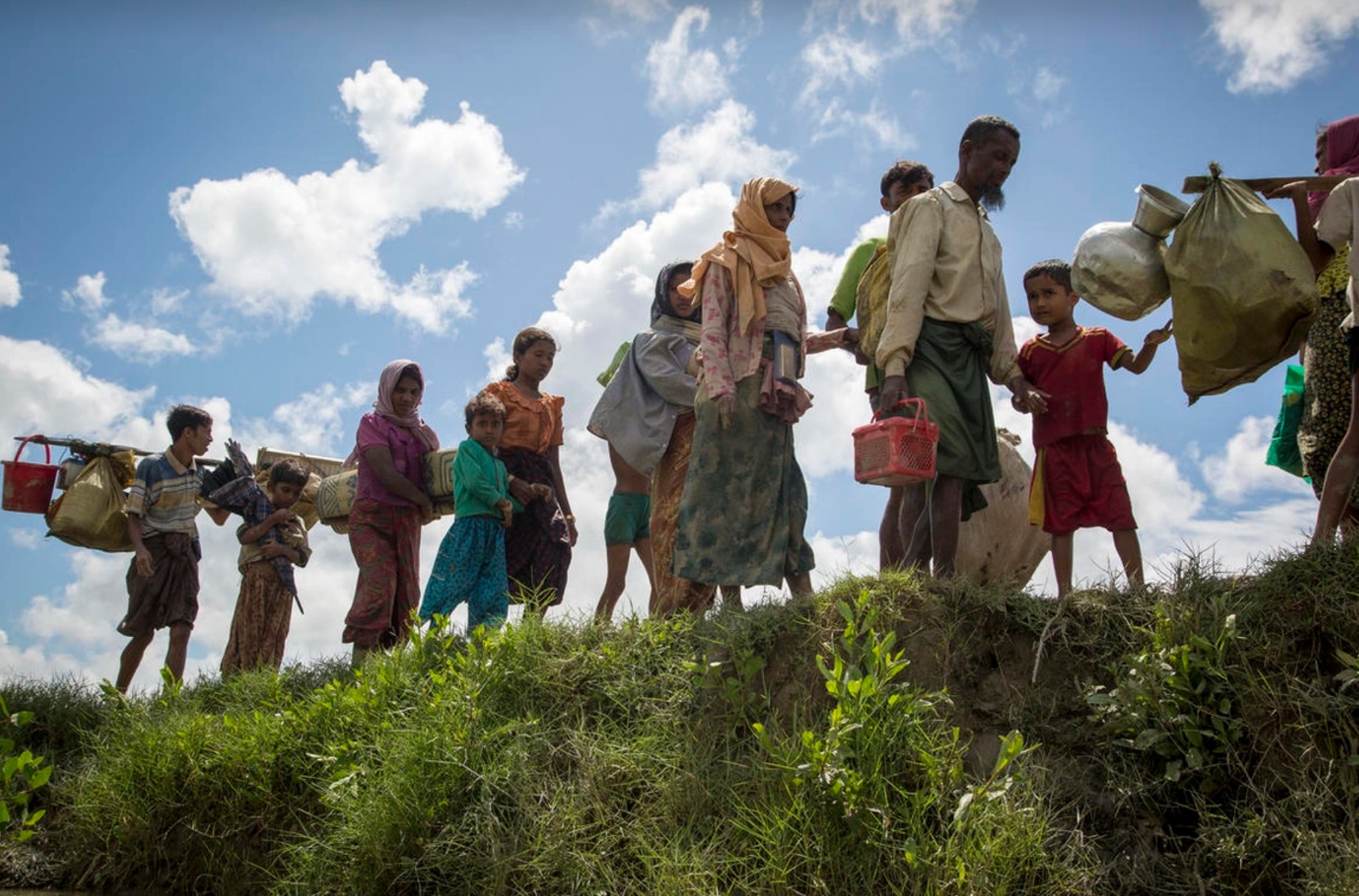
THE first thing that struck me in Cox’s Bazar was the air- thick with dust, tinged with the faint smell of smoke from cooking fires that never quite hide the hunger.
Children ran barefoot through narrow alleys of bamboo and tarpaulin, their laughter brittle, their eyes already older than their years.
I stopped more than once, unsure whether I was intruding on resilience or bearing witness to despair.
In every face, I saw a question that lingers still: “how long must we wait for the world to see us?”
Myanmar’s cruelty continues to metastasise.
A new conscription law now demands that Rohingya men and boys fight for the very army that razed their villages.
It is a grotesque bargain: serve or die, though the truth is that both paths lead to the grave.
And yet, alongside this law, Bangladesh and Myanmar have signed an MoU on “voluntary repatriation.”
The words twist like barbed wire: voluntary, when the choice is between hunger in the camps or death on the frontlines?
This is not return. This is coercion in the guise of diplomacy.
In Dhaka, the Asean Parliamentarians for Human Rights fact-finding mission sat with Chief Adviser Professor Muhammad Yunus.
His presence was calm but urgent, as though he carried the weight of both the crisis and the possibility of its resolution.
We spoke of the futility of aid without structure, of the need to build systems that endure.
We called for an Asean humanitarian fund and for an Asean–Bangladesh–China summit to finally confront the crisis with political teeth.
His words were plain: Bangladesh cannot carry this alone, and the Rohingya cannot remain voiceless forever. “Create a platform that does not exist, now,” he told us. “ASEAN must tell the world about the crisis we are facing.”
His voice still echoes in my mind: part plea, part demand, entirely undeniable.
And yet, Asean hides behind its old shield of “non-interference,” a boys’ club that worships silence over justice.
Malaysia’s chairmanship is almost at its end, and what have we achieved?
Villages continue to burn in Myanmar. The junta grows more entrenched. The Five-Point Consensus lies like a forgotten script, unread and unacted upon.
The cost of ASEAN’s inaction would be devasting: more drugs, arms, refugees
flow into the region.
I am grateful, truly, for Bangladesh, which carries this burden with courage.
But gratitude feels hollow when children go hungry.
The World Food Programme warns that rations will vanish after November 2025 unless USD17 million a month is found.
Already, mothers are planning on skipping meals so their children might eat.
Hunger crouches in the camps like a waiting beast. An Asean Humanitarian Fund is not a luxury but the last thread holding despair at bay.
And then, the children. I think of their voices, reciting fragments of lessons from volunteer teachers in makeshift schools.
Their notebooks are worn, their pencils stubbed, but their hope is intact…for now. If we fail to provide accredited schooling, training, and higher education, that hope will rot into anger.
Education is not only about words and numbers; it is about dignity, about telling a child they have a future worth believing in.
The Philippines has opened its doors to Rohingya students. Others must follow.
Still, I return to the root. The Rohingya must not remain nameless and faceless in Myanmar’s transition.
They must be recognised as a people with rights, with voices that belong in any future of democracy.
Without them, peace will be a performance, brittle and doomed.
Cox’s Bazar is not just a refugee camp. It is a mirror that reflects back our failures and our possibilities.
Walking its narrow paths, I thought of Gaza, two geographies divided by oceans, yet united in abandonment, their people left to carry the unbearable weight of the world’s silence.
The Rohingya crisis is Asean’s test of conscience. Every day that passes without action is another betrayal.
The time for platitudes has passed. The time for decisive, collective action is now, before hope itself becomes another casualty. – September 5, 2025
***Charles Santiago is the co-chair of Asean Parliamentarians for Human Rights (APHR) and former Klang MP