


THE public disagreement within the Malaysian Trades Union Congress (MTUC) has laid bare a longstanding leadership fracture that now threatens the credibility of Malaysia’s oldest and largest labour federation at a critical moment for worker protection reforms.
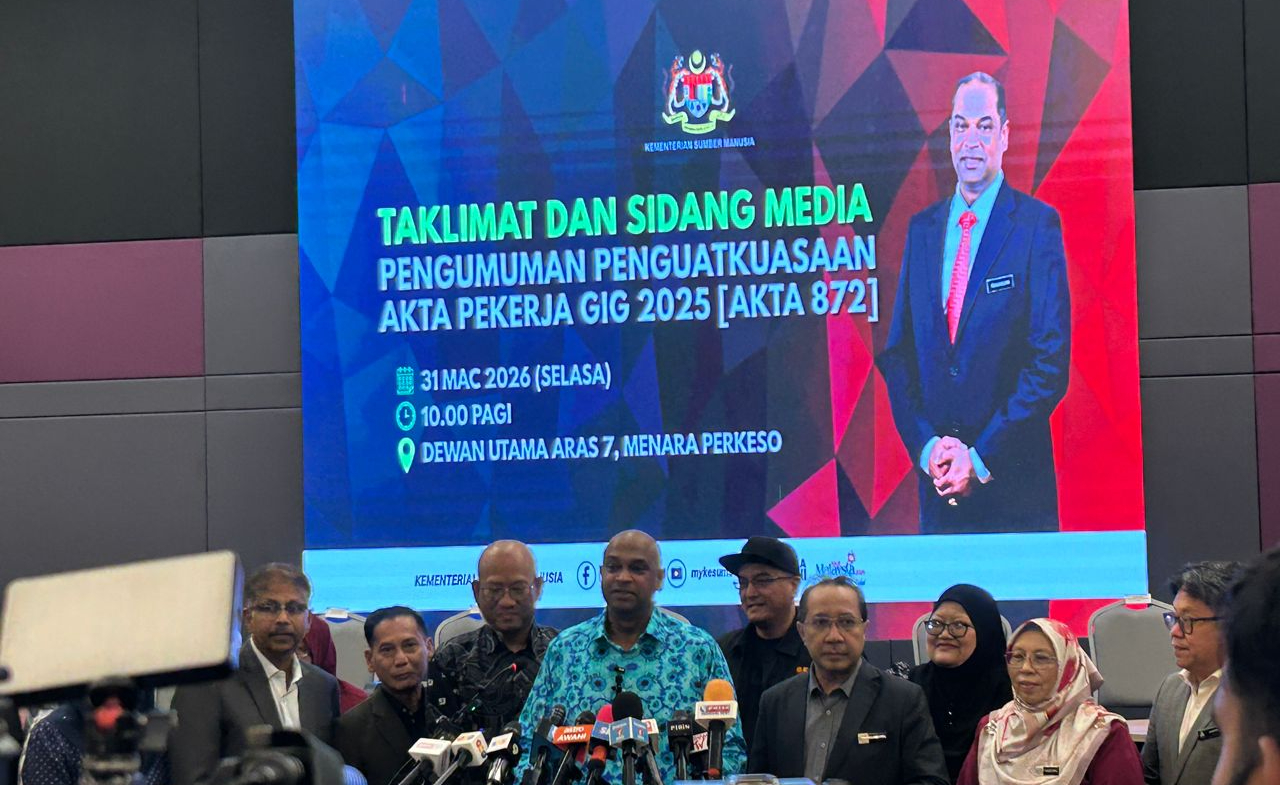
Human Resources Minister Datuk Seri R. Ramanan’s blunt admonishment of MTUC to “get its house in order” yesterday was an executive acknowledgement that internal divisions within the labour movement are spilling into national policymaking.
The dispute erupted over the rollout of the Gig Workers Act 2025, legislation intended to formalise protections for Malaysia’s 1.6 million gig workers.
On March 30, MTUC secretary-general Kamarul Baharin Mansor held a press conference urging the government to delay implementation of the law, arguing that critical issues remained unresolved, including consultation gaps, worker representation mechanisms and ambiguities in definitions affecting gig workers’ rights.
He framed the call not as opposition to reform but as a demand for stronger safeguards before enforcement.
However, at yesterday’s stakeholder briefing and press conference to announce the Bill’s rollout and enforcement, Ramanan, when asked to comment on MTUC’s request not to “rush” the Bill, produced a letter from MTUC president Datuk Abdul Halim Mansor expressing support for the Bill and its immediate rollout — directly contradicting the secretary-general’s public position.
For a moment, the Gig Workers Act was overshadowed by this spectacle of Malaysia’s principal labour body speaking with two opposing voices simultaneously.
Trade unions derive legitimacy from collective representation. When senior leaders publicly contradict each other, the organisation appears unable to consolidate internal consensus before engaging policymakers.
Ramanan’s criticism implicitly highlights this governance failure because government negotiations depend on clarity about who speaks for workers.
Conflicting positions undermine MTUC’s bargaining authority and weaken unions’ negotiating leverage.
MTUC has experienced repeated leadership disputes in recent years, including disciplinary actions and contested leadership transitions that ended up in the courts.
Abdul Halim won the presidency by nine votes in a largely divisive election last August.
Competing centres of authority within the organisation — in the case of MTUC, presidents, secretary-generals — could result in governance and integrity issues, where ultimately workers get the short end of the stick because their representatives are divided and not bargaining from a position of strength.
This factionalism also sends mixed and confusing messages to policy makers and delays the implementation of policies and measures to ameliorate the welfare of the workforce in general.
With 500,000 members and 240 affiliates, the MTUC is a crucial stakeholder in the advancement of workers’ rights and well-being.
The factionalism that is being displayed by MTUC will impact advancements in labour reform.
This drama surrounding the Gig Workers Act reflects structural tensions rather than a single disagreement.
At its core, the dispute reveals differing philosophies within Malaysia’s largest labour movement – one party wants to secure early protections while the other wants a delayed implementation for stronger union rights and clearer safeguards; one wants to accept transitional regulation but the other wants to wait for more clarity.
If unresolved, the crisis could accelerate fragmentation within Malaysia’s union landscape and see MTUC being redundant where sectoral unions or gig-worker organisations will mushroom to bypass MTUC entirely – in fact these organisations already exist and have succeeded in getting the ears of the Minister and policy makers.
Hence the current turmoil may mark a transitional moment rather than merely an organisational dispute.
Ramanan’s warning to “get its house in order” therefore reads more like an epitaph for MTUC where the country’s oldest labour institution risks losing relevance in shaping the future of work. – April 1, 2026
Terence Fernandez is Group Editor in Chief of Big Boom Media which publishes Scoop