

A Saturday night in Klang turned into something far more profound for me: a journey into the living heart of our maritime history, embodied in one tall, slim, 90-year-old man who walked into a packed hall with quiet grace and left all of us in awe.
The venue was The Palmgrove Restaurant in Klang, a familiar landmark suddenly transformed into a sea of navy blue, though in smart casual attire. Officers of all ranks filled the hall, veterans with lined faces and younger men and women still very much in the thick of service. There was laughter, camaraderie, the easy banter of people who have known salt on their skin and duty in their bones.
I was there because of a kind invitation from my dear friend, journalist and commentator Terence Fernandez. For years, I had read and heard about Rear Admiral Tan Sri Dato’ Seri Dr K. Thanabalasingam (Retired), the first Malaysian to be appointed Chief of Navy and the man who helped define what the Royal Malaysian Navy would become. Meeting him had long been on my personal wish list. That night, that long-held wish quietly came true.
When the moment arrived, it was almost cinematic.
The lights dimmed slightly, the chatter softened, and all eyes turned towards the entrance. Ushered in with full naval protocol, he appeared: tall, slender, dignified, dressed in a simple yet elegant black-and-white silk batik. At ninety, he walked with a slight, assisted grace, steady, composed, completely in control of the moment, yet not claiming it loudly.
He didn’t need to.
The hall rose for him, not out of obligation, but out of instinctive respect.
The atmosphere shifted. It felt less like a dinner, more like a homecoming.
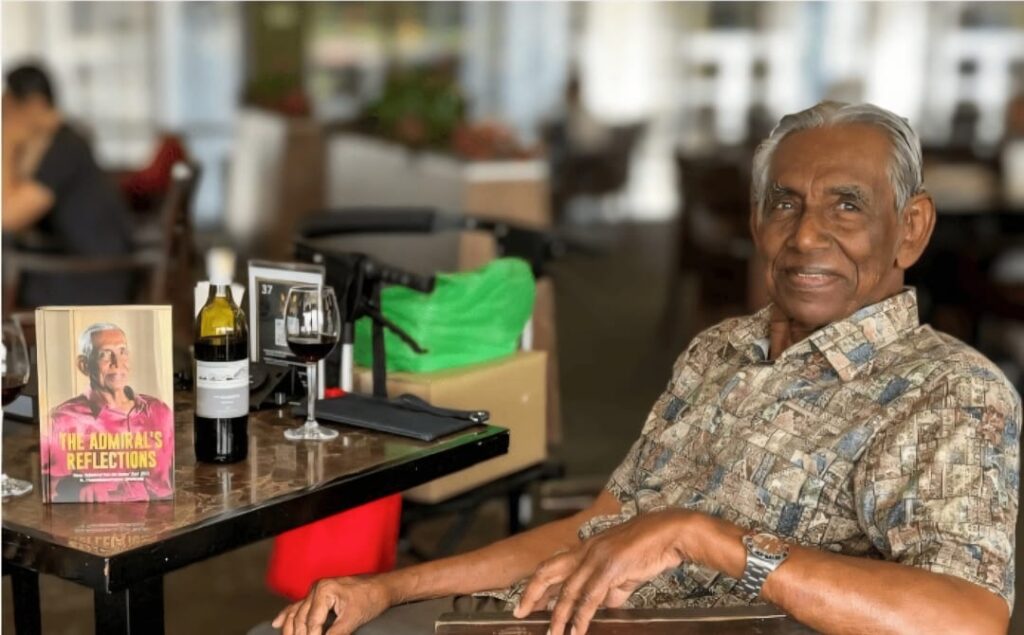
This was no ordinary retiree being honoured for years of service. This was the architect of Malaysia’s modern navy. The man who, at just 31, became the youngest Chief of Navy, and the first Malaysian to hold that post. The man who helped move us from coastal waters to open seas, and from colonial inheritance to sovereign capability.
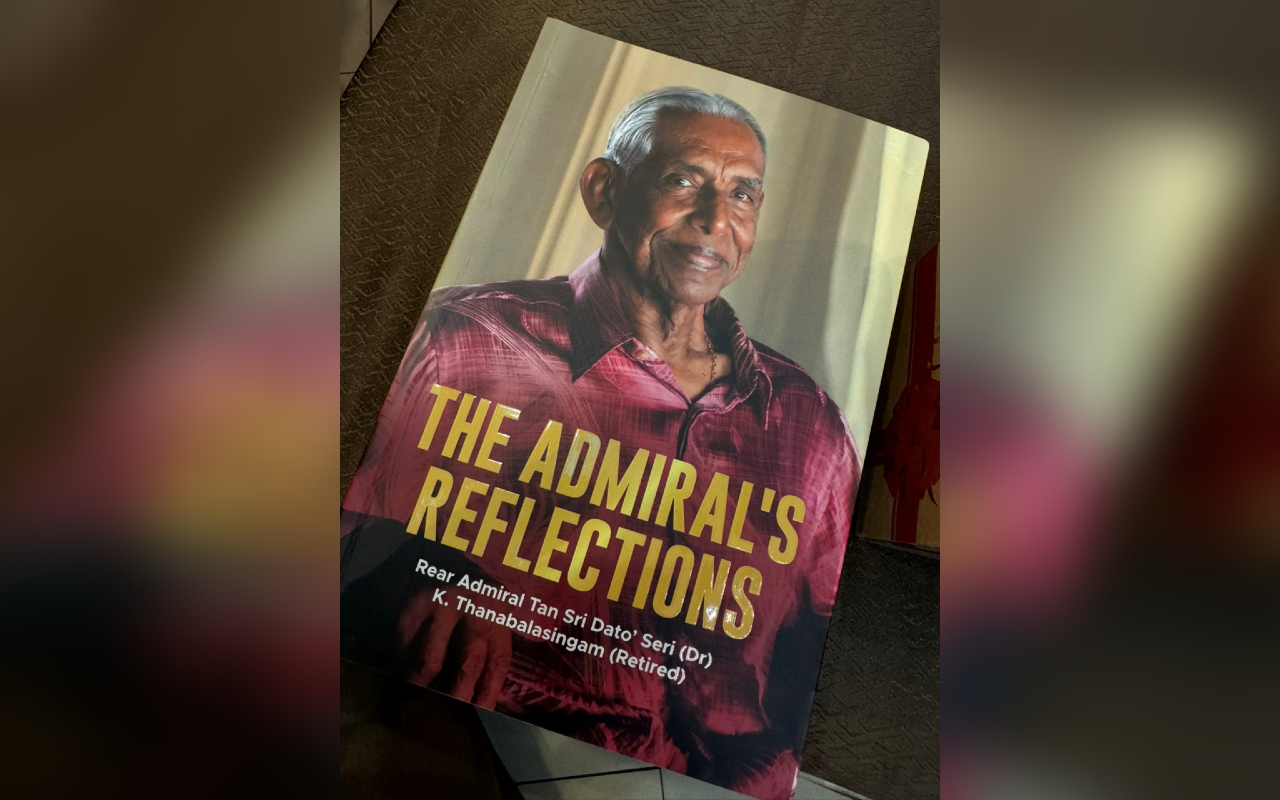
And on this night, there was another reason we gathered: the launch of his latest book, “The Admiral’s Reflections”.
The title itself is disarmingly simple. But as I listened to those who had read early drafts and heard short excerpts, it became clear that this was not a typical military memoir weighed down by dates, operations and self-glorification. Instead, it was a deeply human account of a boy from Kuala Lumpur who grew up to shoulder the weight of a navy and, in many ways, the maritime soul of a young nation.
In conversation and in his writing, the Admiral does not present himself as a born hero. He speaks of his early days with humility, joining the then Royal Malayan Navy in the shadow of British rule, being sent off for training at the Britannia Royal Naval College in Dartmouth, dealing with seasickness, self-doubt and the harsh realities of life at sea.
He writes of night watches where the ocean was pitch black, the air heavy with uncertainty, and how those silent hours forced him to search his own conscience and convictions.
That honesty is what makes his story compelling. It is not bravado. It is courage with context.
As the evening went on, snippets from his journey surfaced in speeches, toasts and quiet anecdotes exchanged at the tables.
There was the story of his appointment as Chief of Navy at 31, an age when most people are still figuring themselves out. Imagine being told that an entire service, with all its ships, bases, and thousands of personnel, would now look to you for command. Where others might have narrated this as a triumphal moment, he has described it more as a sobering one. The pride was there, of course. But so was the weight. So was the question: “Am I worthy of this trust?”
Perhaps the most defining part of his legacy, and one that was repeatedly alluded to that night, is his role in shaping the physical and strategic heart of our navy: the decision to anchor its main base in Lumut.
In an era when Port Klang would have seemed the easier, more convenient and familiar choice, Rear Admiral Thanabalasingam held firm on Lumut. To many, Lumut then must have felt remote, underdeveloped, even impractical. Yet he saw beyond the present. He saw the deepwater advantage, the strategic positioning, the space to grow and evolve. He saw, in short, what the navy would need long after his own time.
It wasn’t a popular stance, and it wasn’t without risk. He had to respectfully hold his ground with leaders he admired, including Tunku Abdul Rahman himself. One can easily imagine the tension of those meetings, the internal conflict between deference and duty. But he chose duty, to the navy, and to the Malaysia that would one day need a base capable of supporting a true blue-water force.
Today, Lumut Naval Base is a living testament to that conviction. When we speak of the Royal Malaysian Navy’s strength, discipline and reach, we are in many ways tracing the contours of a decision made decades ago by a young Admiral who refused to take the convenient route.
What also struck me, listening to those who had served under or alongside him, is the quiet moral compass that seems to have guided him throughout his career. Here was a Malaysian Indian leading one of the country’s key defence arms at a time when the nation was still grappling with identity, race and belonging.
Yet those who talk about him do not reduce him to a symbol. They speak of a man who refused to let race or patronage dictate who rose through the ranks; a leader who believed deeply in merit, professionalism and integrity.
For him, the sea was the great equaliser. Under the uniform, under the flag, everyone served the same cause.
Then, there is the decision that still surprises many: his retirement at the age of 40. In a culture where some cling to power long past their peak, Rear Admiral Thanabalasingam stepped away while still young, having led the navy through crucial years marked by regional tensions and internal consolidation.
In his reflections, he has framed this not as a retreat but as an act of stewardship, recognising that no institution should become the personal domain of a single individual, no matter how decorated.
That, to me, may be one of the most powerful leadership lessons he offers. True leadership is not only about building, commanding and transforming; it is also about knowing when to let go, and trusting the next generation to take what you have built further.
Watching him in that hall in Klang, surrounded by men and women in uniform, retired officers, friends and admirers, I was struck by the extraordinary arc of his life. From a student in Kuala Lumpur to a cadet in Dartmouth, from a young officer at sea to the nation’s first Malaysian Chief of Navy, from the fight for Lumut to the quiet dignity of a nonagenarian statesman launching a book that bridges his youth and his later years.
There was no fanfare on his part. No grand gestures. Just a calm presence that filled the room.
For me, as someone who has long believed that nations are built not only by politicians and policies but by professionals who quietly shape institutions, that evening was a reminder and a reassurance.
Malaysia has produced men and women of deep conviction, intellect and courage. We have, in our midst, individuals who have held fast to principle even when it was uncomfortable, and who have chosen what is right over what is easy.
Rear Admiral Tan Sri Dato’ Seri Dr K. Thanabalasingam is one of them.
We must now match that lifetime of service with the highest honour we can give.
In a country that has rightly conferred the title Tun on political leaders, judges and civil servants, it is time we recognised that nation building also happens on the bridge of a ship and in the quiet conviction of a naval commander who put country above comfort. Rear Admiral Tan Sri Dato’ Seri Dr K. Thanabalasingam did not simply lead a service; he gave Malaysia its maritime spine, its blue water vision, its moral compass at sea.
If the title Tun is to mean anything, it must also embrace men like him, professionals who built institutions, defended our sovereignty, and carried the weight of the flag in the harshest waters without ever demanding the spotlight.
Awarding Tun to this first “old sailor” of our proud nation would not be an act of sentimentality. It would be a clear, overdue statement of what we value: quiet courage, strategic foresight and a lifetime of unwavering, principled service to Malaysia.
A rare few, like this Admiral, spend theirs building a nation’s bearings. Salute you Tan Sri! – April 30, 2026
***Ravindran Raman Kutty is an award-winning PR practitioner