

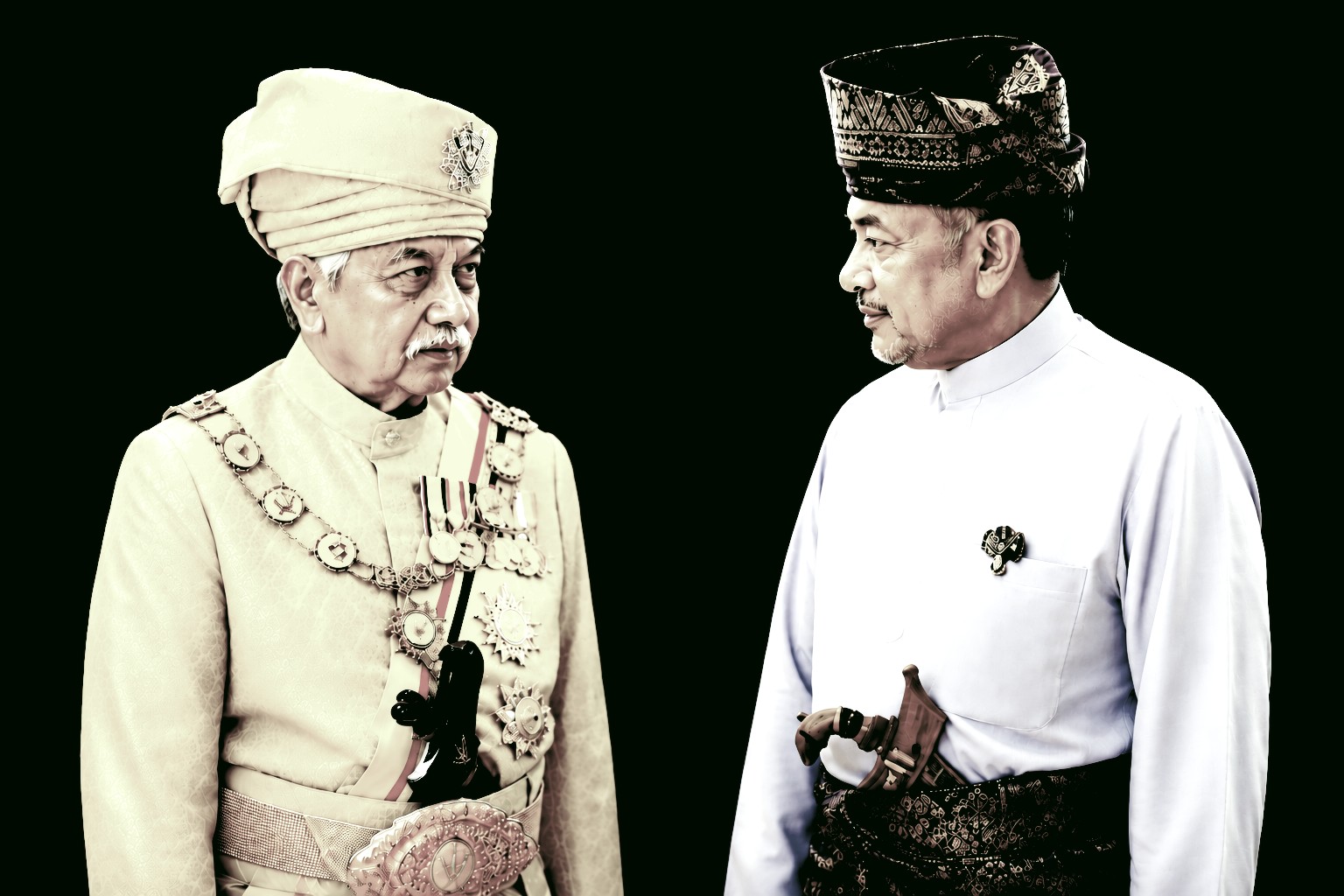

THE dissolution of the Negeri Sembilan State Legislative Assembly on June 4 should have marked the beginning of another routine electoral cycle.
Instead, it has become overshadowed by an unprecedented constitutional controversy — the alleged attempt to remove Tuanku Muhriz ibni Almarhum Tuanku Munawir as the Yang di-Pertuan Besar of Negeri Sembilan.
This is a continuation of drama that began on April 17 when Datuk Mubarak Thahak was removed as the Undang Luak Sungei Ujong for alleged breaches of ceremonial and religious conventions.
The episode continued yesterday with a farcical “installation” of Tunku Nadzaruddin Tuanku Ja’afar as the 12th Yang di-Pertuan Besar at a ceremony held at a hotel in Melaka, after four undangs reportedly proclaimed him as Tuanku Muhriz’s successor.
The matter has since gone to the High Court which granted a status quo in an emergency hearing.
Regardless of one’s political loyalties, views on the complex Yamtuan system in Negeri Sembilan; the palace, or opinions about the personalities involved, one principle must remain non-negotiable: a Ruler cannot be removed simply because he has become inconvenient to the ambitions of others.
That line must never be crossed.
Malaysia’s constitutional monarchy survives because it is anchored on legitimacy, tradition and continuity.
The institution of the Malay Rulers has endured political upheavals, economic crises, changes of government and even constitutional confrontations precisely because there has been a broad national understanding that the monarchy must remain above partisan calculations.
The moment political actors, power brokers or competing interests believe a Ruler can be displaced through pressure, manoeuvring or self-serving schemes, the entire constitutional equilibrium begins to unravel.
Today’s target may be a Yang di-Pertuan Besar. Tomorrow it could be another Sultan. The day after, perhaps a Yang di-Pertuan Agong whose decisions are deemed unfavourable to those holding political power.
Once a precedent is established, it becomes impossible to contain.
This is why the Negeri Sembilan episode is far bigger than one state or one palace.
The state’s unique adat system has for centuries provided a structured and respected process for succession.
It is not perfect, but it has offered stability. Any attempt to circumvent or manipulate that framework risks damaging not merely the institution in Negeri Sembilan but public confidence in constitutional governance itself. The timing is also significant.
The controversy emerges just as the state assembly has been dissolved and the electorate prepares to vote.
Elections are supposed to be contests between political parties seeking a mandate from the people.
Introducing a dispute involving the position of the Yang di-Pertuan Besar injects uncertainty into a process that should otherwise be straightforward.
Political parties come and go. Governments rise and fall. Coalitions are formed and broken.
But constitutional institutions in this case the Royal institution must remain constant.
History offers many lessons about what happens when political factions seek to weaponise institutions that are meant to stand above politics.
Short-term victories often lead to long-term instability. What begins as an effort to remove one individual eventually weakens the institution itself. That is why the issue should concern Malaysians far beyond Negeri Sembilan.
The question is not whether one agrees with Tuanku Muhriz on any particular matter. The question is whether Malaysia is prepared to accept a future where constitutional rulers can become vulnerable to political engineering.
If the answer is yes, then no ruler, no institution and ultimately no constitutional safeguard can ever be considered secure.
The abdication of Sultan Muhammad V of Kelantan as Yang di-Pertuan Agong on Jan 6, 2019 – eight months after a coalition lead by Tun Dr Mahathir Mohamad took power from Barisan Nasional in the 14th General Elections – remains a matter of unhealthy speculation.
Which is why statements by Prime Minister Datuk Seri Anwar Ibrahim and Negeri Sembilan Menteri Besar Datuk Seri Aminuddin Harun recognising Tuanku Muhriz as the present and rightful ruler are timely as they give clarity to the people, politicians, investors, the business community and civil servants that the present leadership structure is solid.
The strength of Malaysia’s constitutional monarchy has never been derived from force. It comes from respect for established rules and an acceptance that some institutions must remain insulated from the shifting winds of politics.
The dissolution of the Negeri Sembilan assembly should have been about allowing the people to choose their representatives.
Instead, it has become a reminder of how fragile constitutional order can become when ambition overtakes principle.
For the sake of Negeri Sembilan and for Malaysia as a whole, this controversy must end with a reaffirmation of constitutional norms, not their erosion.
Because once the precedent is set that a Ruler can be removed through political convenience or self-serving manoeuvres, the consequences will not stop at the palace gates. – June 7, 2026
Terence Fernandez is co-founder of Big Boom Media which publishes Scoop, along with Datuk Zainul Ariffin and Datuk Ahirudin “Rocky” Attan.