

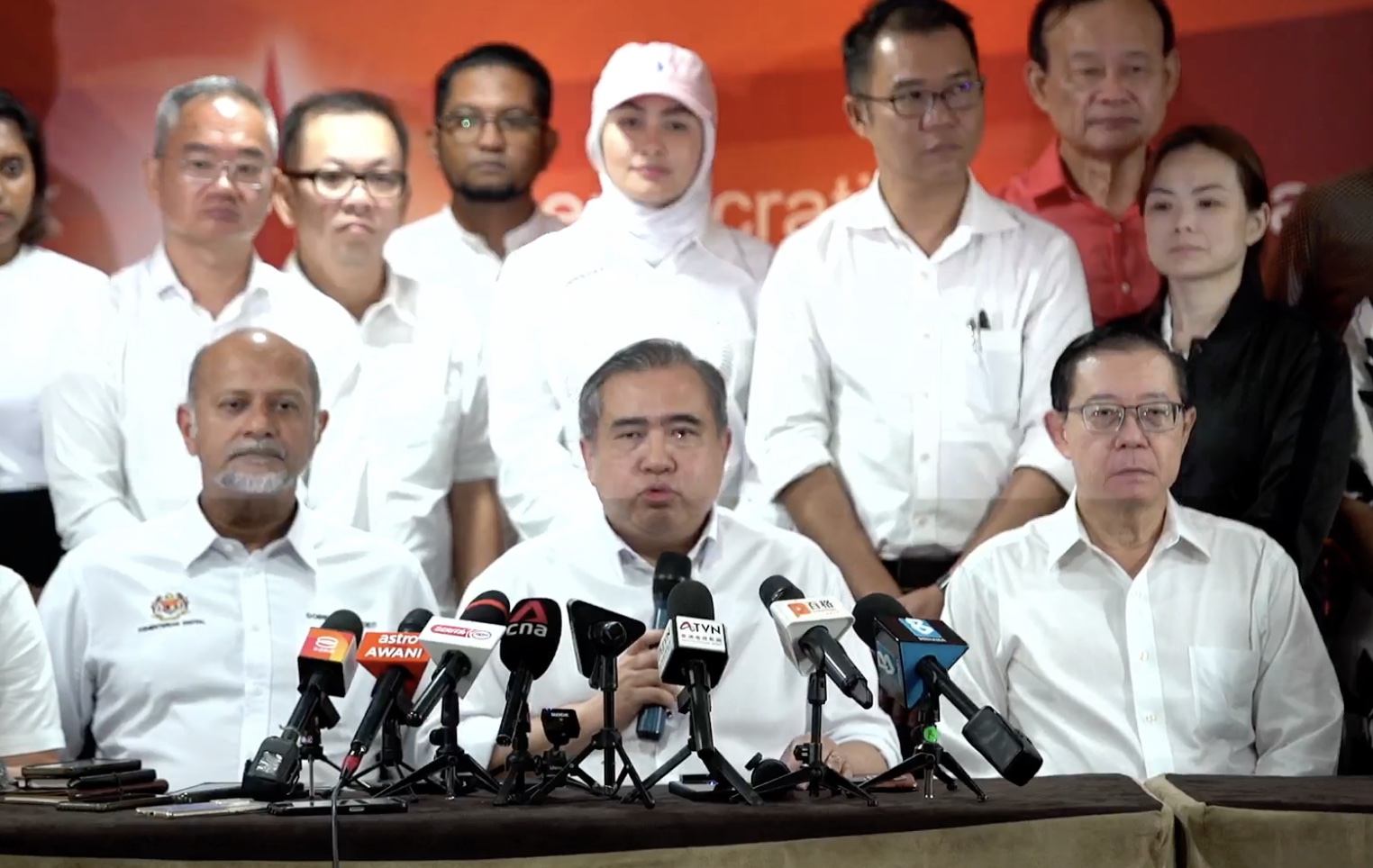

KUALA LUMPUR — DAP secretary-general Anthony Loke’s decision to offer his resignation as Transport Minister over the decision allowing former prime minister Datuk Seri Najib Razak to serve the remainder of his sentence under house arrest has raised some interesting questions about the party’s position and its role in the unity government.
Loke said the decision was made by the DAP Central Executive Committee (CEC) as the party’s response to the matter, while stressing that DAP respects the Yang di-Pertuan Agong’s constitutional authority to grant pardons.
But there is one obvious question that follows:
Why only Anthony Loke?
If the issue is serious enough for DAP’s secretary-general to offer to leave the Cabinet, why have the party’s other ministers and deputy ministers decided to remain in government?
Loke himself has explained that the resignation only involves him, while other DAP ministers and deputy ministers will remain in the government to ensure political stability.
That is a reasonable political explanation.
But it also opens the door to a wider discussion about principles, responsibility and consistency.
If DAP considers the decision on Najib’s house arrest fundamentally difficult to reconcile with its principles and values, why is one minister carrying the political cost while the rest continue serving in Cabinet?
This is not about attacking Loke personally.
In fact, he deserves credit for putting his own Cabinet position on the line.
But precisely because he has taken that step, DAP should also explain what the resignation is intended to achieve beyond demonstrating the party’s disagreement.
If political stability requires the other DAP ministers to remain in government, then that is a position Malaysians can understand.
After all, governing requires compromise.
But it also raises a question about how far political compromise can go before it begins to sit uneasily with a party’s principles.
DAP has said it respects the King’s constitutional power to grant pardons. Loke also said Federal Territories Minister Hannah Yeoh had expressed her views honestly and candidly while carrying out her responsibilities as a member of the Federal Territories Pardons Board.
That distinction matters.
Yeoh’s role should not be portrayed as an endorsement of the decision simply because she was a member of the board.
The issue, therefore, is not whether every DAP minister personally supported the decision.
The bigger political question is this:
If DAP’s response is to have its secretary-general leave the Cabinet, why is that response limited to one minister?
Perhaps the party believes Loke’s resignation is enough to demonstrate its opposition while allowing the unity government to continue functioning.
Perhaps that is the balance DAP believes it needs to strike.
If so, Malaysians are entitled to ask whether this is primarily a matter of principle, political strategy, or a combination of both.
And that is where politics becomes interesting.
DAP remains part of Prime Minister Datuk Seri Anwar Ibrahim’s unity government.
Loke offers to leave.
The other DAP ministers remain.
The government continues.
So what exactly changes?
Does Loke’s resignation simply become a symbolic protest?
Does DAP retain its influence in Cabinet while demonstrating that it is unhappy with the decision?
And does the move put additional political pressure on Anwar without threatening the stability of the government itself?
These are legitimate questions arising from the political arrangement DAP has chosen.
Then there is another question that Malaysians may naturally ask:
Who is putting pressure on whom?
If DAP believes the decision crosses an important line, is the resignation intended to put pressure on the Prime Minister?
If so, what does DAP ultimately want to achieve?
And if the party remains in government, how far is it prepared to take that disagreement?
Again, these are questions, not accusations.
But they are questions that come with being part of a coalition government.
Malaysians understand coalition politics.
They know parties make compromises.
They know parties sometimes have to work with political rivals.
They also know that governing means making decisions that may not satisfy everyone.
DAP itself demonstrated that political reality after GE15, when it agreed to work with Barisan Nasional and UMNO to form the unity government.
That was a major political development after years of rivalry between DAP and UMNO.
The argument then was largely about political stability and the need to form a functioning government.
Perhaps that was necessary.
But if political realities can justify working with former political adversaries, then it is fair to ask whether political realities can also explain why DAP’s other ministers remain in Cabinet over the Najib issue.
That is where the question of consistency comes in.
If compromise is necessary to form a government, can compromise also be necessary to keep that government functioning?
DAP can answer that question.
And perhaps it should.
Because 2026 is very different from the political landscape of previous years.
Malaysians are more politically aware, and they are watching how parties balance principles with the practical realities of governing.
They are also dealing with issues that have little to do with political manoeuvring.
The latest official figures show Malaysia’s inflation rose to 1.9% in August 2026 from 1.8% in July. Transport costs rose 2%, while housing, water, electricity, gas and other fuels increased 2.1%. Food and beverages also rose 1.9%.
The government has acknowledged that Malaysians are still facing cost-of-living pressures, with Anwar announcing six immediate measures in August covering areas including fuel subsidies, school maintenance, healthcare digitalisation, AI, e-Invoicing and microfinancing.
These are the issues that affect people every day.
Families are thinking about household expenses.
Young Malaysians are thinking about housing.
Workers are thinking about wages and job security.
Small businesses are thinking about operating costs.
Parents are thinking about education and healthcare.
Public transport users want reliable and affordable services.
These are not abstract political principles.
These are people’s lives.
And if DAP still wants to be seen as a party that puts people first, then these issues should receive just as much political attention as the battles taking place inside Putrajaya.
Take the cost of living.
Take housing.
Take public healthcare.
Take public transport.
Take wages.
Take opportunities for young Malaysians.
Take the survival of small businesses.
These are the areas where Malaysians will ultimately judge every political party, not simply by what it says during a political controversy, but by what it delivers when it has the power to govern.
Anthony Loke has made his choice.
He has offered to give up his Cabinet position.
That is his decision.
But DAP’s decision is something different.
The party has chosen to remain in government while allowing one of its most senior leaders to step aside.
That is why questions will continue to be asked.
Not because Malaysians do not understand politics.
Quite the opposite.
They understand that every resignation, every statement and every coalition decision has political consequences.
Perhaps this is principle.
Perhaps it is a political strategy.
Perhaps it is both.
But if political stability is the reason the rest of the DAP ministers are staying in Cabinet, DAP should be comfortable saying so clearly.
And if principles and values remain at the heart of the party, then Malaysians will reasonably expect those principles to be applied consistently.
Because it is 2026.
People are watching.
And perhaps the real question for DAP is not simply where Anthony Loke goes from here.
It is where the party itself goes from here. – September 22, 2026
T. Vignesh is the Executive Editor of Scoop.my