

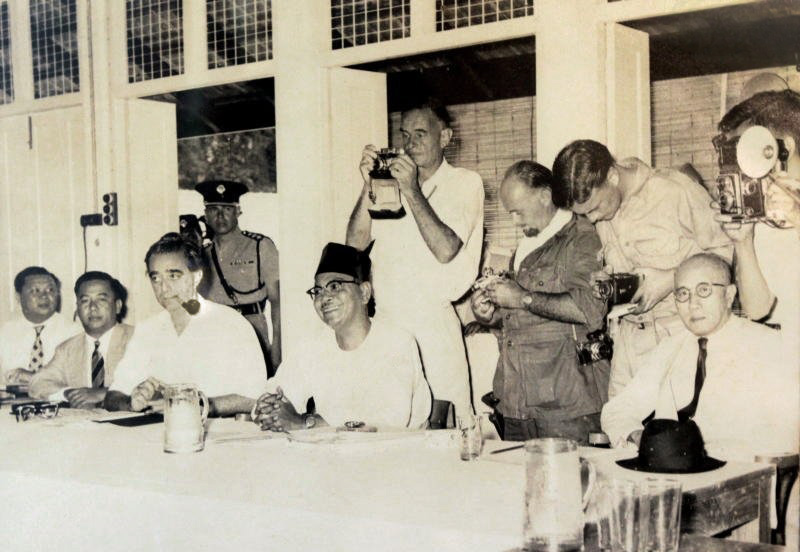
THE comparison with Malaysia’s first Prime Minister, Tunku Abdul Rahman, and Chin Peng is seductive, but it is also deeply misleading. The 1955 Baling talks took place in a very different context: the Communist insurgency had been substantially weakened, and Chin Peng was negotiating from a position very different from that of Min Aung Hlaing today.
To invoke Tunku and Chin Peng as a neat historical justification for giving the head of Myanmar’s military a state welcome is to strip history of its context.
Yes, diplomacy requires talking to adversaries. Nobody disputes that. The question is who you are talking to, what leverage you have, what has been tried before, and what you are actually achieving.
And this is where the defence of Prime Minister Anwar Ibrahim’s meeting with Min Aung Hlaing vanishes, Houdini style.
Myanmar has not lacked dialogue. It has lacked compliance.
Since the adoption of ASEAN’s Five-Point Consensus in 2021, ASEAN Special Envoys and member states have conducted hundreds of consultations and political engagements. Malaysia itself has undertaken an extraordinary number of engagements. Indonesia has too. ASEAN has spent years talking, negotiating, persuading and attempting to bring the Myanmar military towards a political solution.
And what has happened?
The violence has continued. The displacement has grown. The killing has continued. The bombing of civilians has continued. If the bombings in Gaza matter, this matters too.
The Five-Point Consensus has not failed because ASEAN did not talk enough. It has failed largely because the Myanmar military has refused to meaningfully implement it.
That distinction matters.
While ASEAN was talking, the Myanmar military was bombing ethnic areas. On September 28, the eve of Malaysia’s first major deportation of Myanmar detainees, a military airstrike near a market in Kyauktaw, Rakhine State, killed at least 49 people and injured scores more. The United Nations described the attack as further evidence that conditions in Rakhine remain unsafe for return.
And yet Malaysia proceeded with the return of 1,476 Myanmar nationals the following day. According to alternative media and people on the ground, some 1000 were sent to the notorious Insein prison in Yangon. The PM’s aide, Muhammad Kamil Abdul Munim, cannot dispute this because we didn’t bother setting up a monitoring mechanism before deporting them.
Malaysia now says the repatriation process will continue beyond the initial 5000, with the Immigration Department saying there is no fixed quota and that, if possible, it wants them all to return.
So when we are told that dialogue with Min Aung Hlaing is necessary to solve the refugee problem, we should ask a very simple question: what evidence is there that meeting him will stop the violence that is producing the refugees in the first place?
Refugees do not flee because ASEAN has insufficient diplomatic meetings. They flee because their homes are being bombed, their villages are attacked, their communities are persecuted and their lives are unsafe.
The idea that the refugee flow will somehow end after a meeting between Anwar and Min Aung Hlaing is ignorance. The flow will end when the violence ends. And there is very little in Min Aung Hlaing’s record to suggest that he is a reliable or trusted negotiating partner who can be assumed to deliver that outcome.
This is not an abstract assessment for me.
In January 2018, I led an ASEAN Parliamentarians for Human Rights delegation to examine the Rohingya crisis at the early stages of what would become recognised as a genocidal campaign. I met women who described being gang-raped by soldiers and affiliated vigilantes. I met an elderly man who told us that young people had been lined up beside a river and shot one by one until, he said, the river ran red. I met an older man who, crying as he spoke, described Myanmar soldiers entering his home, killing his young grandchildren and then raping his daughter.
These are not statistics to me. They are people I met.
Min Aung Hlaing was the commander-in-chief of the Myanmar military during the campaign against the Rohingya. The then International Criminal Court prosecutor, Karim Khan, has sought an arrest warrant against him over alleged crimes against humanity involving the persecution and deportation of Rohingya. That is not equivalent to having been tried or convicted at the ICC but it should certainly make us ask whether he is the sort of partner to whom Malaysia should be extending the symbolism and ceremony of a state visit.
And the Rohingya crisis is not some historical footnote. It is one of the primary reasons over a million fled Myanmar for safety in Bangladesh and Malaysia.
So yes, talk to adversaries. But diplomacy is not merely about having a conversation. It is about leverage, accountability, consequences and outcomes. Why should we believe that another bilateral conversation will succeed where years of ASEAN engagement have failed? And why should Malaysia’s engagement be framed as somehow equivalent to Tunku Abdul Rahman sitting down with Chin Peng?
There is another important difference.
When Anwar met representatives of Myanmar’s National Unity Government during Malaysia’s ASEAN chairmanship, they did not arrive in Kuala Lumpur with the power of the Myanmar military behind them. Indeed, the NUG leadership operates under extraordinary security constraints precisely because its members face arrest, imprisonment and death at the hands of the junta. That imbalance is important when we talk about “engaging all stakeholders”.
Meeting an opposition representative remotely while receiving the junta chief with an official welcome, military honours and a state-level reception are not politically equivalent acts simply because both can technically be described as “dialogue”.
Diplomacy has symbolism. That symbolism matters. And Min Aung Hlaing certainly understands it. His tour of ASEAN capitals serves a purpose beyond conversation: it helps legitimise and normalise his international status and provides an image of a leader who can travel, meet heads of government and conduct business as usual while his military continues to wage war at home.
His visit to Malaysia comes at a particularly extraordinary moment when Malaysia is simultaneously sending Myanmar nationals back to the very country from which many have fled, while negotiating further returns with the authorities in Naypyidaw. Reuters has reported that repatriation is among the key issues surrounding the visit.
That is why the question is not whether Anwar is “allowed” to talk to Min Aung Hlaing. Of course he is. The question is what Malaysia is conceding in the process and what it is getting in return.
A credible negotiation requires credible commitments. And Min Aung Hlaing’s record is precisely why those commitments cannot simply be taken at face value.
If Malaysia wants the refugee flow to stop, it should demand the conditions that would make return possible: an end to attacks on civilians, meaningful political dialogue, humanitarian access, protection of ethnic communities, citizenship rights and the right of displaced Rohingya to return safely to their homes and land.
If Malaysia wants to be a serious mediator, then it must be an honest one. That means talking to everyone and not just the person with the guns.
It means using Malaysia’s leverage rather than merely offering hospitality. It means putting the protection of civilians ahead of diplomatic theatre. And above all, it means recognising a very simple truth: you cannot negotiate refugees out of existence.
And after five years of ASEAN diplomacy, hundreds of consultations and continued bloodshed, I together with civil society organisations, Myanmar communities, human rights defenders, are entitled to ask: if all this dialogue has produced no meaningful change, why should another handshake be mistaken for progress?
Charles Santiago is former Klang MP