

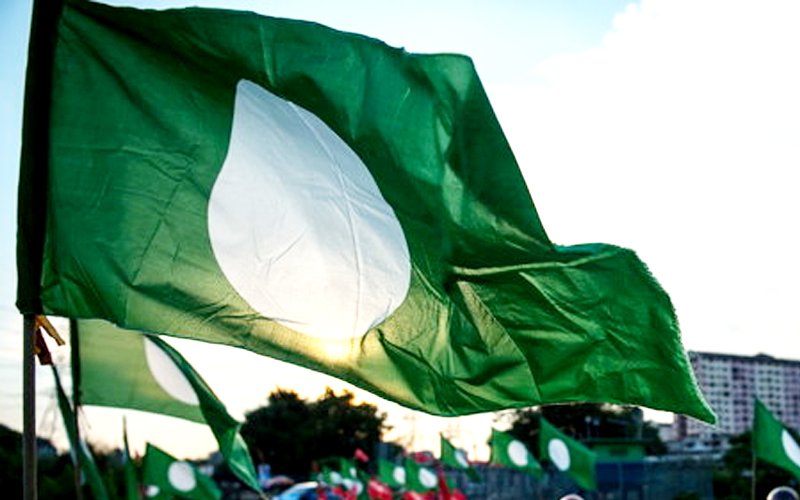
I MUST admit, among Malaysia’s many political leaders, Tan Sri Abdul Hadi Awang is not exactly someone whose political style I particularly admire.
This is not a personal attack. Everyone is entitled to his political preference. But when someone carries the title of an Islamic scholar, I expect a little more caution, wisdom and responsibility when speaking in public.
Now, let’s examine this rather interesting business involving the Dajjal.
On 29 October 2026, the MADANI Government signed a Confidence and Supply Agreement (CSA) with 13 non-government MPs. These included six Bersatu MPs led by Tan Sri Muhyiddin Yassin, six former Bersatu MPs sitting as independents, and Muar MP Syed Saddiq Syed Abdul Rahman.
The agreement was intended to secure support for Budget 2027 and certain institutional reforms, including limiting the Prime Minister’s tenure to two terms and separating the roles of the Attorney-General and Public Prosecutor.
On 3 November 2026, at approximately 6.38pm, PAS president Abdul Hadi Awang published his criticism of the agreement. He described the CSA as a “Dajjal approach at the end of times”, arguing that political power was being turned from an amanah into a mechanism for forcing people to remain in power.
Now, that is quite a description for a parliamentary agreement.
A political agreement can be criticised. Its clauses can be questioned. Its intentions can be challenged. That is democracy.
But must we bring the Antichrist into the meeting room as well?
THE INTERESTING PART: WHO PROPOSED IT FIRST?
Here is where the story gets rather uncomfortable.
On 5 November 2026, Prime Minister Anwar Ibrahim responded to Hadi’s remarks after attending the Prime Minister’s Golden Hand Award 2026 ceremony at Universiti Teknikal Malaysia Melaka (UTeM), Durian Tunggal, Melaka.
According to MalaysiaGazette’s report, Anwar reminded the public that the earlier proposal for a political cooperation memorandum had originated from Perikatan Nasional, which included PAS and Bersatu.
He specifically mentioned PAS secretary-general Datuk Seri Takiyuddin Hassan, together with Datuk Seri Hamzah Zainudin and several others from the government at the time.
In other words, the political arrangement that is now being criticised has a history that PAS itself cannot simply pretend never existed.
Let’s go back to 2021.
On 13 September 2021, at 5.00pm, the Federal Government under then Prime Minister Datuk Seri Ismail Sabri Yaakob signed the Memorandum of Understanding on Transformation and Political Stability with Pakatan Harapan at the Banquet Hall of Parliament, Kuala Lumpur.
The agreement covered parliamentary reforms, administrative transformation, judicial independence, the Malaysia Agreement 1963 and other areas of cooperation.
PAS was part of the government at that time. Its senior leaders were serving in the Cabinet.
To be fair, the 2021 MoU was not the same document as the 2026 CSA. But the principle of political cooperation between government and opposition was certainly not new.
So, here is my question:
When political cooperation was being discussed during the Ismail Sabri administration, was it acceptable? And when a similar principle appears under another administration, suddenly we are talking about Dajjal?
Well, that is an interesting change of vocabulary.
As the old saying goes, “people in glass houses should not throw stones.”
TOO MUCH CONSPIRACY, TOO LITTLE SUBSTANCE
One weakness I increasingly notice among certain PAS leaders is their tendency to turn ordinary political disagreements into something much bigger, sometimes involving religious warnings, end-of-times predictions and conspiracy narratives.
I have no objection to religious principles being part of politics. Religion can provide moral guidance. But it should never become a convenient weapon to silence questions or discredit political opponents.
If the CSA is wrong, show us which clause is wrong.
If it threatens the rakyat, explain how.
If it creates an unfair arrangement, provide the evidence.
That is how serious political criticism works.
You do not need to bring the entire cast of the end-times narrative into a parliamentary debate just to disagree with a government.
Sometimes a simple explanation is more powerful than a thousand dramatic statements.
“And honestly, if I were given the responsibility of choosing the next PAS president, I would seriously consider Dato’ Seri Ir. Dr. Ahmad Samsuri Mokhtar, better known as Dr. Sam.”
He is an aerospace engineer by training, holds a PhD from the University of Leeds and currently serves as Terengganu Menteri Besar. He is also a PAS vice-president.
I am not suggesting that he is perfect. No politician is. But I would prefer to see more emphasis on professional competence, policy, administration and practical solutions.
A party should not have to depend on dramatic political statements to demonstrate its strength.
Sometimes, the quietest person in the room has the most interesting things to say.
PERHAPS THEY SHOULD STUDY THE PROPHET’S POLITICAL LEADERSHIP
Now, let us return to something more important.
If certain political leaders wish to present themselves as defenders of Islam, perhaps they should spend more time studying how Prophet Muhammad SAW conducted leadership and dealt with politics.
The Prophet was not merely a religious preacher who delivered sermons and left the affairs of society to somebody else.
After the Hijrah in 622 CE, he became the leader of the emerging Muslim community in Madinah.
He established a political and social framework that brought together different tribes and communities, including Muslim groups and Jewish communities.
One important historical document associated with this period is the Constitution of Madinah.
It dealt with mutual responsibilities, security, dispute resolution, cooperation and the relationship between different communities.
The Prophet also engaged in diplomacy, negotiated agreements, consulted his companions and entered into treaties with other parties.
The Treaty of Hudaybiyyah in 628 CE is a particularly important example. Rather than insisting on confrontation, he accepted a negotiated agreement even when some of its terms appeared difficult to his own followers.
That was political maturity.
He understood that leadership was not about winning every argument, humiliating every opponent or turning every disagreement into a battle.
It was about protecting society, maintaining justice, keeping promises and making decisions for the greater good.
There is a lesson here for modern politicians.
You can be religious without being unnecessarily confrontational. You can defend your principles without insulting others. You can disagree with the government without suggesting that everyone on the other side represents evil.
Politics requires wisdom, not just volume.
And being an Islamic leader should come with an even greater responsibility to demonstrate good character.
THE FINAL ENTRY
I have no intention of defending every decision made by Anwar Ibrahim or his government. Governments must be questioned. Opposition parties must be allowed to criticise. Nobody should receive a free pass.
But religious language should not be used carelessly, especially by people who carry the responsibility of religious leadership.
There is a difference between giving religious guidance and using religion as a political instrument.
Perhaps that distinction deserves more attention than another round of political name-calling.
“Beyond the Dajjal, there is something I fear even more… and that is the Ulama Su’ (corrupt or evil religious scholars).” – (Our Beloved) (Narrated by Ahmad from Abu Dharr RA)
Sometimes, the greatest danger is not the Dajjal… it’s the ‘religious figures’ themselves (regardless of the religion). – November 6, 2026
***Jepry is a nickname for Haziq Hamid, former Malaysian crime journalist (999) 2019-2021 and content producer (Astro Radio) 2023