

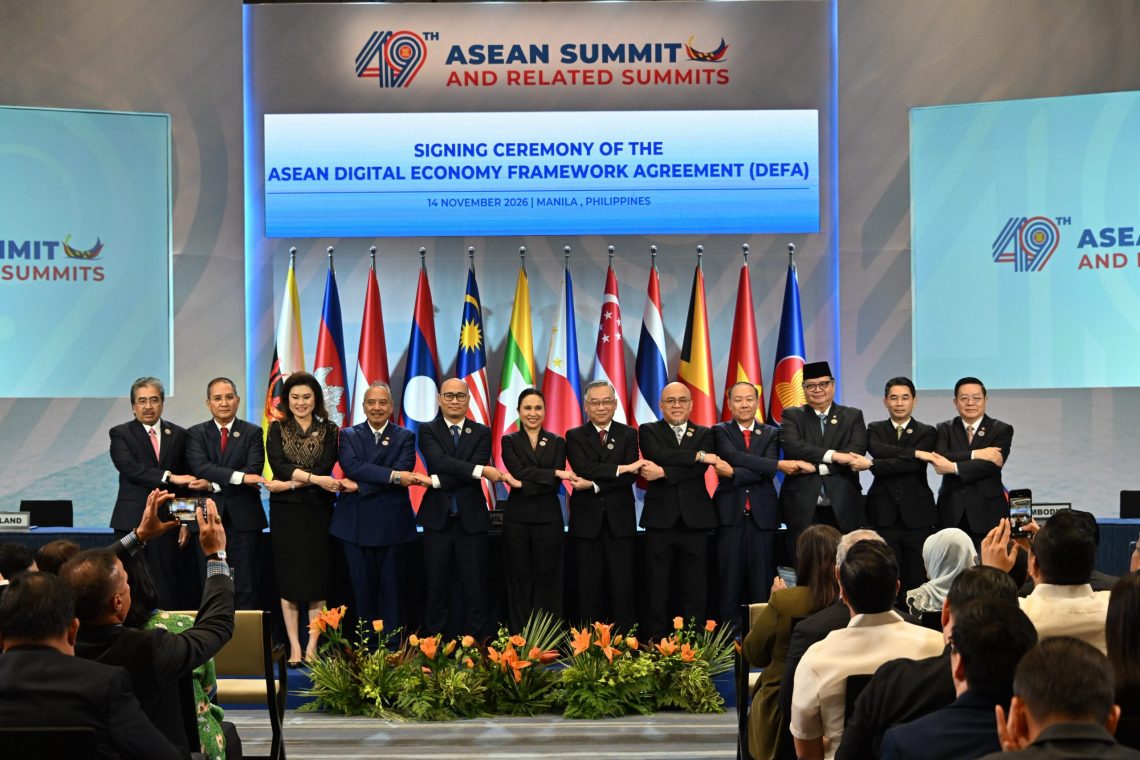
Two halves of one digital future: DEFA and ACCS
ASEAN’s new Cybersecurity Cooperation Strategy 2026–2030 (ACCS) comes at a defining moment for
Southeast Asia. With the landmark Digital Economy Framework Agreement (DEFA) signed in Manila ahead of the 49th ASEAN Summit, ASEAN has established both an ambitious roadmap for economic integration and a shared commitment to defend it.
These two frameworks are inherently linked. As geopolitical friction, extreme climate, IT outages and cyber threats increasingly threaten the critical infrastructure and essential services millions of people depend on, a more interconnected economy must also be far better protected.
DEFA represents the growth engine of ASEAN’s digital future, connecting around 700 million people and
helping ASEAN’s digital economy grow towards US$2 trillion by 2030 driven by cross-border digital trade, interoperable payment systems, digital identity, and AI cooperation. Yet every digital connection introduced to accelerate commerce simultaneously creates a shared operational dependency.
ACCS serves as the indispensable resilience shield. Together, they represent the two essential halves of
Southeast Asia’s long-term digital stability.
Interdependence creates cascading cross-border vulnerabilities
Across Southeast Asia, the physical and digital foundations of society are deeply intertwined. Energy grids, municipal water systems, telecommunications arteries, and financial networks do not operate in national silos. A disruption affecting an interconnected utility or cloud provider in one capital can rapidly trigger cascading vulnerabilities across financial clearings, supply chain logistics, and public services in neighbouring states.
This shared vulnerability is especially acute as ASEAN accelerates integration across physical infrastructure, from the multilateral ASEAN Power Grid to shared subsea fibre corridors and regional data-centre clusters spanning Malaysia, Singapore, and Indonesia. In an integrated digital trade corridor, a cybersecurity compromise at an outsourced maintenance contractor or regional logistics clearinghouse ceases to be a single domestic incident; it becomes a contagion risk for the entire economic community. The ability to respond collaboratively is therefore just as vital as the sovereign ability to defend nationally.
The operational blind spot: Why content encryption is not enough
Building cross-border resilience requires more than perimeter firewalls and data-residency laws.
When critical infrastructure operators or government departments face severe cyber disruption, networks may need to be isolated to contain an attack. But isolating networks must never mean isolating national leadership. Governments, frontline responders and National Critical Information Infrastructure (NCII) operators need independent, out-of-band communications that remain operational when primary enterprise systems do not.
Informal crisis coordination, however, can default to consumer messaging applications when an incident
strikes. While these platforms may provide end-to-end encryption, encryption alone does not address three critical risks: exposed metadata, uncertainty about the identity of those communicating, and a lack of auditable records for reporting and accountability.
Metadata can reveal who is communicating with whom, when and how frequently, enabling an adversary
using AI to map command hierarchies and identify key decision-makers without decrypting a single message.
AI-enabled impersonation and spoofing compound that risk, particularly during periods of disruption when conventional systems cannot be relied upon and nations are more vulnerable to attack.
Secure, sovereign crisis communications must therefore protect not only message content and metadata, but the verified identity of every participant and an auditable record of decisions.

Tested at scale: The 2025 ASEAN summit operational proof point
Sovereign cross-border crisis coordination is not an abstract concept; it has already been proven at the
highest diplomatic level. During the 2025 ASEAN Summit events hosted in Malaysia, the ASEAN Secretariat deployed dedicated secure communications and critical incident management platforms – specifically BlackBerry AtHoc and SecuSUITE – to coordinate hundreds of operational personnel and maintain continuous, out-of-band command channels.
This mission-critical deployment safeguarded logistical, operational, and security coordination for thousands of international delegates and world leaders throughout fast-moving regional meetings. It proved that inter-agency collaboration can be executed rapidly and securely without compromising national sovereignty, surrendering administrative control of internal systems, or exposing communications to public networks.
Translating ACCS into reality requires establishing this exact standard of operational readiness across
emergency services, energy grids, and cross-border transport corridors.
Building the human resilience layer: Scaling skills across ASEAN
A strategy on paper only becomes effective when the people executing it have built shared muscle memory.
Building long-term operational readiness requires practical scenario testing, cross-sector simulation
exercises, and sustained human capital development across the region. When an incident occurs, response speed depends on whether leaders across different agencies and member states already know and trust each other.
Malaysia’s leadership in championing the ACCS provides a regional model for practical capability building.
Through the Malaysian Communications and Multimedia Commission (MCMC) and BlackBerry Cybersecurity Centre of Excellence (CCoE) in Cyberjaya, more than 12,000 cyber-defenders have already been trained.
Backed by strategic partnerships, including investment from the Government of Canada to support cyber
leadership training for women and professionals across ASEAN, the facility demonstrates how public-private collaboration can cultivate the workforce required to anchor regional defence. This international backing for the MCMC and BlackBerry CCoE advances the capacity-building component of the United Nations framework of responsible state behaviour in cyberspace, placing this unified government-industry effort within a globally recognised approach.
Turning ambition into regional resilience
Southeast Asia now possesses the essential architecture for its digital destiny: an economic framework in DEFA to connect the people across the region, and a security strategy in ACCS to safeguard their digital livelihoods. But the ultimate test of regional integration will not be measured by the economic transactions completed during peacetime. It will be judged by how effectively member states coordinate, communicate, and maintain vital public services during moments of acute crisis.
By embedding sovereign communications into national infrastructure, protecting sensitive metadata, and investing continuously in the human resilience layer, ASEAN can ensure that its digital transformation is not only dynamic and inclusive, but fundamentally enduring. Digital integration and digital sovereignty must reinforce one another – and trusted communications are what will hold the two together. – November 18, 2026
Tash Stamatelos is Senior Vice President, Secure Communications, Asia-Pacific at BlackBerry. He oversees government, defence, and enterprise secure communications across the APAC region, supporting national authorities, regulated critical infrastructure, and international bodies in deploying sovereign communications and critical event management infrastructure