

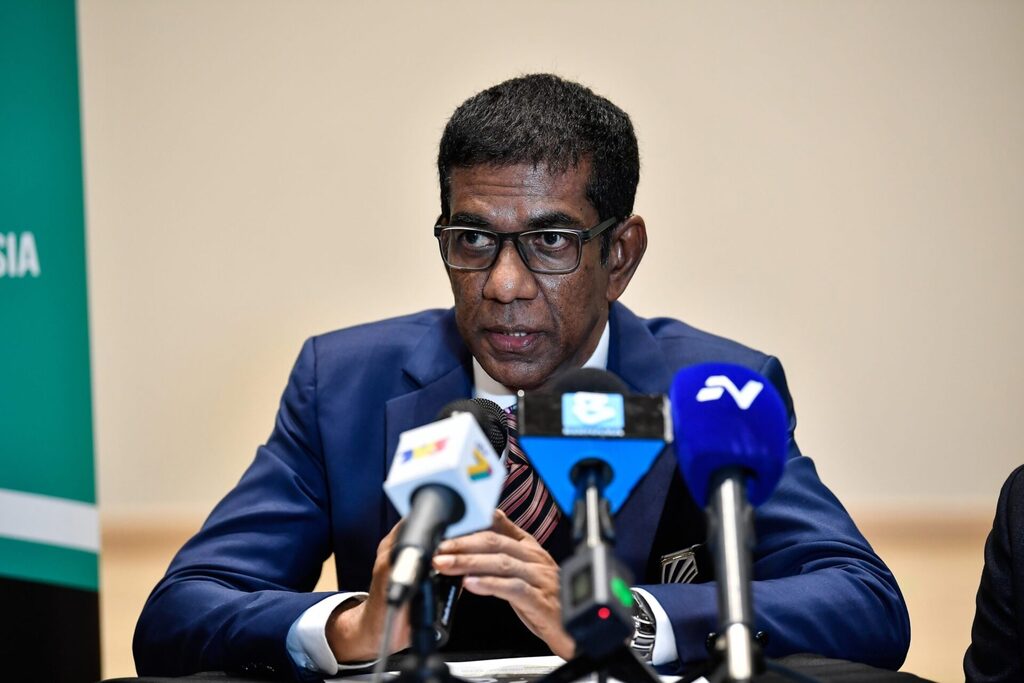

KUALA LUMPUR – As Malaysia grapples with the inconsistent performances of its junior badminton players on the international stage, some argue the solution lies not in demanding more from the athletes, but in rebuilding the system that produces them.
Leading this call for change is Deputy President II of the Badminton Association of Malaysia (BAM) and President of the Kuala Lumpur Badminton Association (KLBA), Datuk Seri Jahaberdeen Mohamed Yunoos.
Speaking on Scoop’s Sport Check podcast recently (which will be published on Tuesday), Jahaberdeen contrasted the proactive, schools-first approach he has championed in KL with what he describes as a systemic vacuum at the national level.
While poor tournament results often invite criticism of players, Jahaberdeen believes the real issue is a weak foundation that undermines long-term success.
To prove his point, he cites KLBA’s “Jejak Juara” programme — now in its third year — which has redefined grassroots badminton in Kuala Lumpur.
Instead of waiting for talent to emerge, KLBA goes directly to the source: schools.
“You must go to the schools,” Jahaberdeen stressed, explaining how KLBA has engaged all 294 schools in Kuala Lumpur, building an ecosystem of 3,300 young players.
This has been made possible through a key partnership with the Kuala Lumpur Federal Territory Education Department (JPWPKL), which has also earmarked a dedicated “badminton school” for the city, complete with a hostel for promising young shuttlers.
“I’m very blessed that there’s a new Pengarah (director) who’s equally excited about development,” Jahaberdeen noted, emphasising the importance of cooperation with non-sporting bodies.
However, this success highlights what he sees as a glaring weakness in Malaysia’s national strategy.
“I am surprised to see that these countries actually have a national blueprint for junior development,” he said, referring to badminton powerhouses like China, South Korea, and Indonesia.
“Malaysia has no such unified plan,” he added, calling the current system disjointed and ineffective.
Jahaberdeen was particularly critical of BAM’s national junior circuit, which he bluntly labelled a syok sendiri (self-amusing) system that creates a false sense of competition. He described how the circuit’s structure splits the 15 states into three groups of five, meaning players only compete within their group until the final stage.
“The five only fight among themselves,” he explained, adding that this setup prevents the creation of a proper national ranking system and leaves the country guessing about who its best juniors truly are. His solution: a national knockout system from the very first round.
“By doing that, we can have a ranking in the country,” he said, enabling proper seeding and a clearer measure of talent.
Ironically, despite its success and vision, KLBA faces a major hurdle — it is homeless. For six years, the association has operated as a “nomad,” renting private courts and lacking a permanent home.
Jahaberdeen admitted feeling “embarrassed” when meeting other state BA presidents who have state-backed facilities. He has appealed to the Mayor of Kuala Lumpur to grant KLBA an arena, which would allow it to expand its programmes and host an ASEAN Inter-City badminton tournament.
Ultimately, Jahaberdeen’s message is a rallying cry: for Malaysia to regain its status as a badminton powerhouse, it must move beyond quick fixes and reactionary criticism.
It needs a shift in mindset, a willingness to adopt proven blueprints like KLBA’s, and the courage to overhaul outdated systems from the top down. – August 9, 2025