

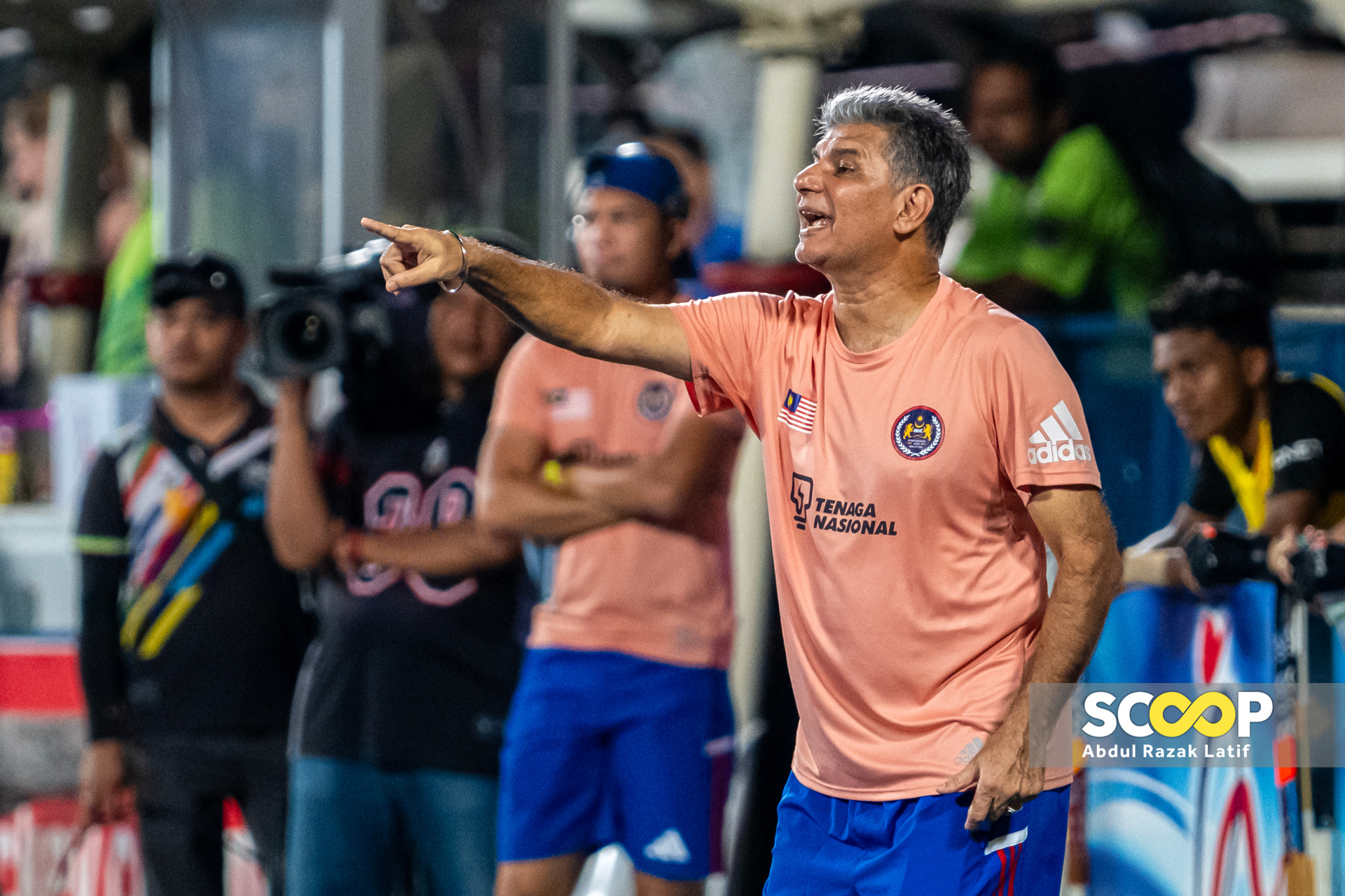


KUALA LUMPUR — “I was made a scapegoat,” Sarjit Singh has said of his dismissal as national men’s hockey coach, just weeks after securing Malaysia’s place at the World Cup.
“It’s not fair. It came as a shock. I couldn’t believe it,” he told Scoop, describing the decision as unjust and symptomatic of deeper structural flaws in the sport.
The 63-year-old said there was no warning or review prior to the non-renewal of his contract. He had not even managed to present his post-tournament report.
“The call came late on Sunday (March 14 ). By Monday (March 15), I was told my contract would not be extended. They had not even seen my report,” he said when contacted.
Sarjit said he was informed by Malaysian Hockey Confederation (MHC) coaching and development committee chairman Datuk Majid Manjit Abdullah before meeting president Datuk Seri Subahan Kamal, who cited dissatisfaction with Malaysia’s world ranking.
Sarjit said he questioned the basis of the decision, noting he had met the target for World Cup qualification, set at the start of his tenure.
“When I took the job, I said give me two years. If I don’t qualify, I will resign. I kept my word,” he said.
Malaysia qualified for the 16-team World Cup in the Netherlands and Belgium, to be held this August, via world rankings after finishing fourth at the qualifier in Egypt earlier this month.
“If the target set for me was to qualify for the World Cup, and I achieved it, then on what basis am I being removed?” he said.
“That is why I feel I have been made a scapegoat.”
Beyond his exit, Sarjit pointed to what he described as the real issue — a lack of depth in the national setup.
“The bigger problem is not the coach. We are not ready,” he said.
“We need more players, not short-term call-ups but a system that produces quality. We need two teams. At the moment, there is no backup.”
He said the lack of depth has forced reliance on a core group of senior players, several in their mid-30s, while younger replacements remain unprepared.
“You cannot just throw young players into international hockey. They need time. The problem is replacements are not ready,” he said.
Recent heavy defeats underline the gap with top nations, including losses to England (7-1), Germany (10-1) and Belgium (9-1).
“This is not a one-off. It is a pattern,” he said.
Sarjit said those matches were deliberately arranged to benchmark the Speedy Tigers against elite opposition.
“What we saw was a widening gap,” he said, adding that late-game lapses and poor decision-making under pressure continue to cost the team.
He also flagged inconsistencies in goalkeeping and below-par penalty corner conversion, noting Malaysia scored just eight from 31 attempts in Egypt.
“At this level, that is not enough. These are match-defining moments,” he said.
Sarjit urged stronger international collaboration to accelerate development, pointing to Chile’s progress with Argentina and suggesting Malaysia tap into Australia’s high-performance system.
“We are four and a half hours from Perth. If we can work with them, we can move forward,” he said.
With the World Cup looming, Sarjit struck a cautious tone on expectations, with Malaysia drawn alongside Germany, Belgium and France.
“It will be tough. Finishing 11th to 13th would be realistic,” he said.
He maintained he holds no ill will towards his players, but warned that without systemic change, results will remain unchanged.
“Change the coach, but if the system does not change, the outcome will be the same,” he said.
MHC announced on March 18 that Sarjit’s contract would not be renewed following a run of poor results, with South African Brendon Carolan set to take over from April 1.
Sarjit, who was appointed in March 2024, oversaw a dip in Malaysia’s world ranking from 13th to 15th, with the team winning just two of five matches at the World Cup Qualifier in Egypt and advancing based on ranking.
Carolan, who previously worked with the national setup and has experience in Europe, is expected to arrive this week. He will be tasked with rebuilding the squad, with key targets including the Nations Cup in June and the Asian Games. – March 30, 2026