

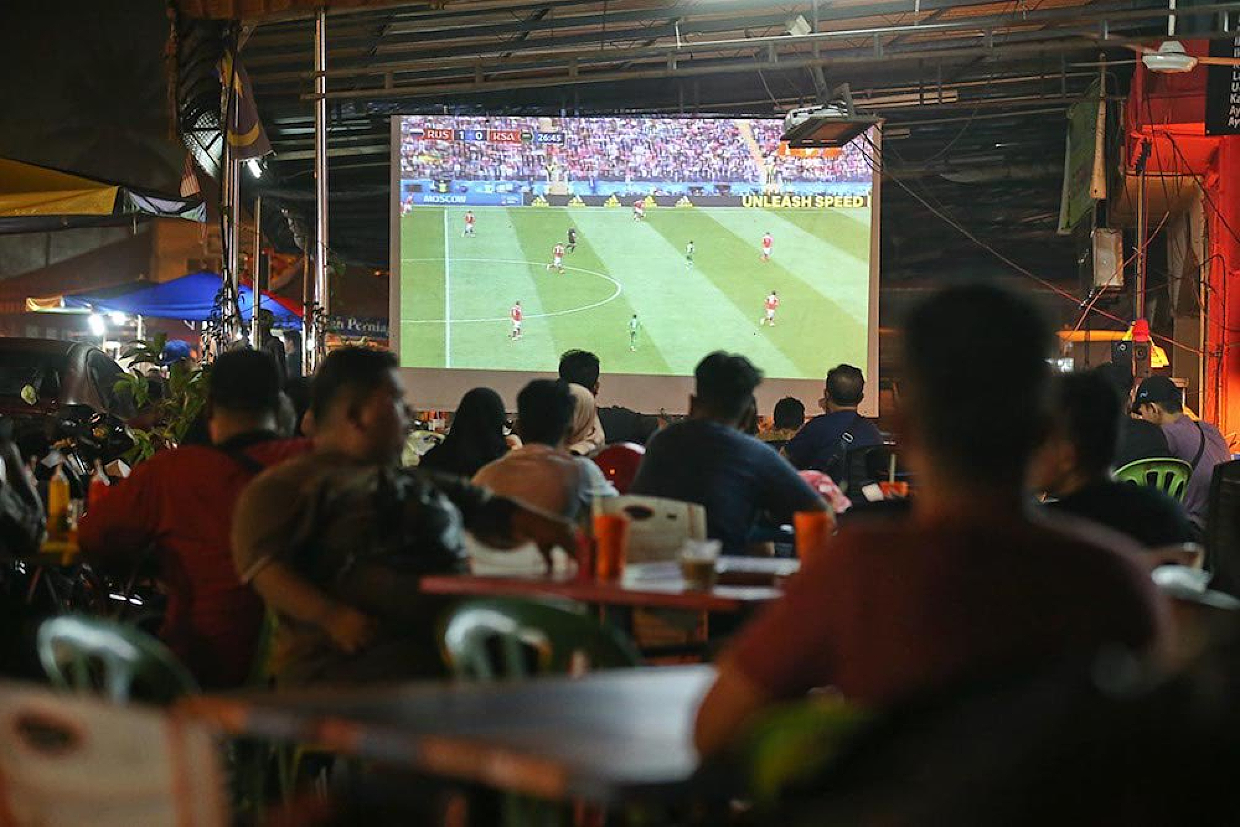

KUALA LUMPUR – Government intervention is critical to ensure Malaysians are not shut out of the 2026 FIFA World Cup, with calls growing for free-to-air access amid uncertainty over broadcasting rights.
Senior lecturer at UiTM’s Faculty of Sports Science and Recreation, Datuk Pekan Ramli, said involvement from key entities such as the Communications Ministry, the Youth and Sports Ministry and Telekom Malaysia is “very necessary” to guarantee equitable access for football fans across the country.
He stressed that access to the World Cup should not be limited by cost barriers, noting that inclusive broadcasting plays a broader role in sustaining Malaysia’s football culture.
“The absence of live broadcasts will affect the interest of the younger generation. Malaysia will feel as though it is in mourning,” he said when contacted.
Pekan described the tournament as a vital platform for inspiring youth, building sporting culture and exposing fans to the highest level of the game.
He warned that without live coverage, young Malaysians would lose a key source of inspiration, particularly from global stars, while also missing defining moments that shape their passion for football.
“It is not just about watching matches. It is about maintaining and nurturing football culture in the country,” he said, adding that access to top-level football also helps improve technical understanding through international benchmarks and strengthens national unity.
On possible solutions, Pekan said a cost-sharing model involving government-linked companies (GLCs), major corporations and relevant ministries remains a practical approach.
He noted that such collaboration could improve the efficiency of public spending, reduce duplication of efforts and generate spillover benefits for the local economy, particularly for businesses that depend on matchday crowds.
However, he cautioned that any such initiative must be backed by strong governance.
“The approach is realistic, but it requires transparent and efficient management to ensure it is not misused,” he said.
Offering a contrasting view, fellow sports analyst Sadek Mustaffa argued that the absence of official broadcasts may not significantly impact Malaysians, given the availability of alternative viewing platforms.
He said football does not currently position Malaysia as a major force on the world stage, limiting the tournament’s broader national significance compared to sports such as badminton.
“The World Cup only creates temporary excitement, especially since the national team is not involved. The interest fades quickly,” he said.
Sadek added that while young players may still be inspired by emerging international stars, the tournament’s influence does not fully extend across society due to economic, social and political constraints.
He also pointed to growing cost-of-living pressures, suggesting that public priorities are increasingly focused on daily necessities rather than sporting access.
“In the current climate, basic needs take precedence. Funding football broadcasts is not a priority compared to essential expenses,” he said.

Despite differing perspectives, both analysts acknowledged that football remains embedded in Malaysian society, particularly at the grassroots level.
With negotiations over broadcasting rights still ongoing, the outcome will likely determine whether Malaysians can collectively experience the world’s biggest football spectacle or be left on the sidelines.
The debate comes amid growing uncertainty over whether Malaysia will secure rights to the 2026 FIFA World Cup, with FIFA reportedly demanding around RM200 million for the expanded 48-team tournament hosted across North America.
Astro Malaysia Holdings has seen declining profits and rising costs, while RTM’s historical coverage has been limited to selected matches, raising questions over affordability and commercial viability.
Senior analyst and consultant at Global Asia Consulting, Samirul Ariff Othman, yesterday warned that Malaysia could forgo between RM70 million and RM180 million in direct economic activity if it fails to secure broadcasting rights for the FIFA World Cup 2026, with the broader spillover potentially exceeding RM200 million to RM300 million.
With negotiations reportedly stalled and the tournament drawing closer, stakeholders now face a difficult question: whether the World Cup remains a commercially justifiable broadcast investment, or a national consumption event whose value extends beyond the balance sheet.
Adding to the concern, Malaysia is not alone in facing this dilemma. India — the world’s most populous nation, with an estimated 1.47 billion people, is reportedly in a similar position, with no official broadcaster confirmed thus far for both the 2026 and 2030 World Cup editions.
Across the Causeway, however, Singapore fans are already assured of full coverage after Mediacorp secured rights for the world’s biggest football competition. – April 15, 2026