

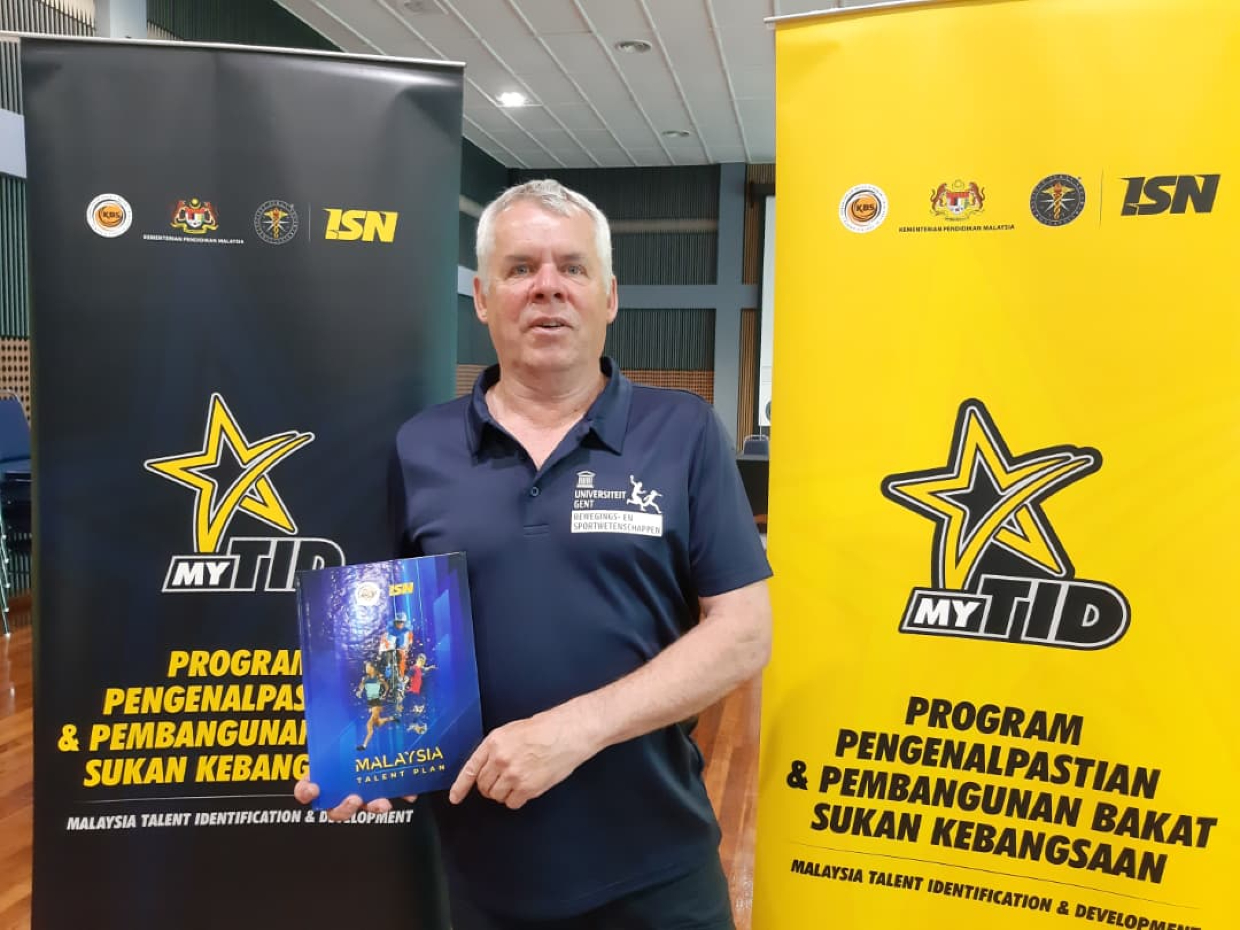

KUALA LUMPUR – The National Sports Institute (NSI) has conducted testing involving around 15,000 schoolchildren under the developing National Sports Talent Plan (MyTP), as Malaysia moves towards a more data-driven approach to athlete development amid concerns that over-coaching and early specialisation may be limiting long-term sporting potential.
Speaking exclusively to Scoop, Professor Emeritus Dr Johan Pion, a sports science and talent identification expert and architect of the Sport Compass system, said large-scale testing is only the starting point of a much longer development process, stressing that the real challenge lies in how the data is applied to coaching and athlete progression.
“We have already tested around 15,000 children in Malaysia,” he said.
“But testing alone is not the solution. The real question is how you interpret the data and how you translate it into better coaching decisions and better long-term athlete development.”
Pion said youth sport systems often place too much emphasis on structured training and early competition outcomes, which can unintentionally restrict long-term development.
“In many systems, we start coaching children too early and too intensively,” he said.
“Winning becomes the focus far too soon, instead of developing fundamental movement skills and allowing children to explore different sports.”
He warned that early specialisation may narrow the talent pool by excluding athletes who develop later physically or biologically.
“If you specialise too early, you reduce the chances of discovering hidden talent,” he said.
“Children should be given the opportunity to try different sports before being channelled into a single pathway.”
Pion said Malaysia’s evolving framework under MyTP is designed to address these issues by combining structured testing with more scientific athlete profiling, allowing for more objective and long-term talent identification.
He also highlighted Malaysia’s badminton development system as a key example of how data-driven selection can uncover elite potential that traditional methods may miss.
“In the Badminton Association of Malaysia (BAM), we worked with under-12 boys and girls during the selection process in 2018,” he said.
“The head coach selected nine players, and based on our data, we also selected nine players. Two (Kang Khai Xing and Aaron Tai) of them were not in the official selection.”

He said Khai Xing and Aaron were initially questioned due to differences in age and biological maturity, but later proved their potential at elite level.
“They had two main challenges—relative age difference and biological maturity,” he said.
“At that age, those differences are extremely significant.”
“Six years later, those players became world junior champions under 21. That is a very strong validation of the system.”
Pion said the case demonstrated the importance of combining sports science with coaching judgment, rather than relying solely on youth competition results.
“You can call it a lucky case, but when you see similar patterns across sports like taekwondo, gymnastics and cycling, it is no longer luck,” he said.
“It becomes a system.”
He added that Malaysia’s long-term ambition under MyTP is to establish a more coordinated, evidence-based talent development framework across all National Sports Associations, aimed at improving long-term performance outcomes.
The National Sports Talent Plan (MyTP) is a strategic national framework led by NSI to strengthen athlete development in a more systematic, structured and data-driven way.
It focuses on improving how sporting talent is identified, developed and supported across all National Sports Associations (NSAs) through sport-specific development plans and closer collaboration between stakeholders.
In essence, MyTP aims to build a more coordinated and evidence-based talent development system to enhance Malaysia’s long-term performance at international sporting level. – May 26, 2026