

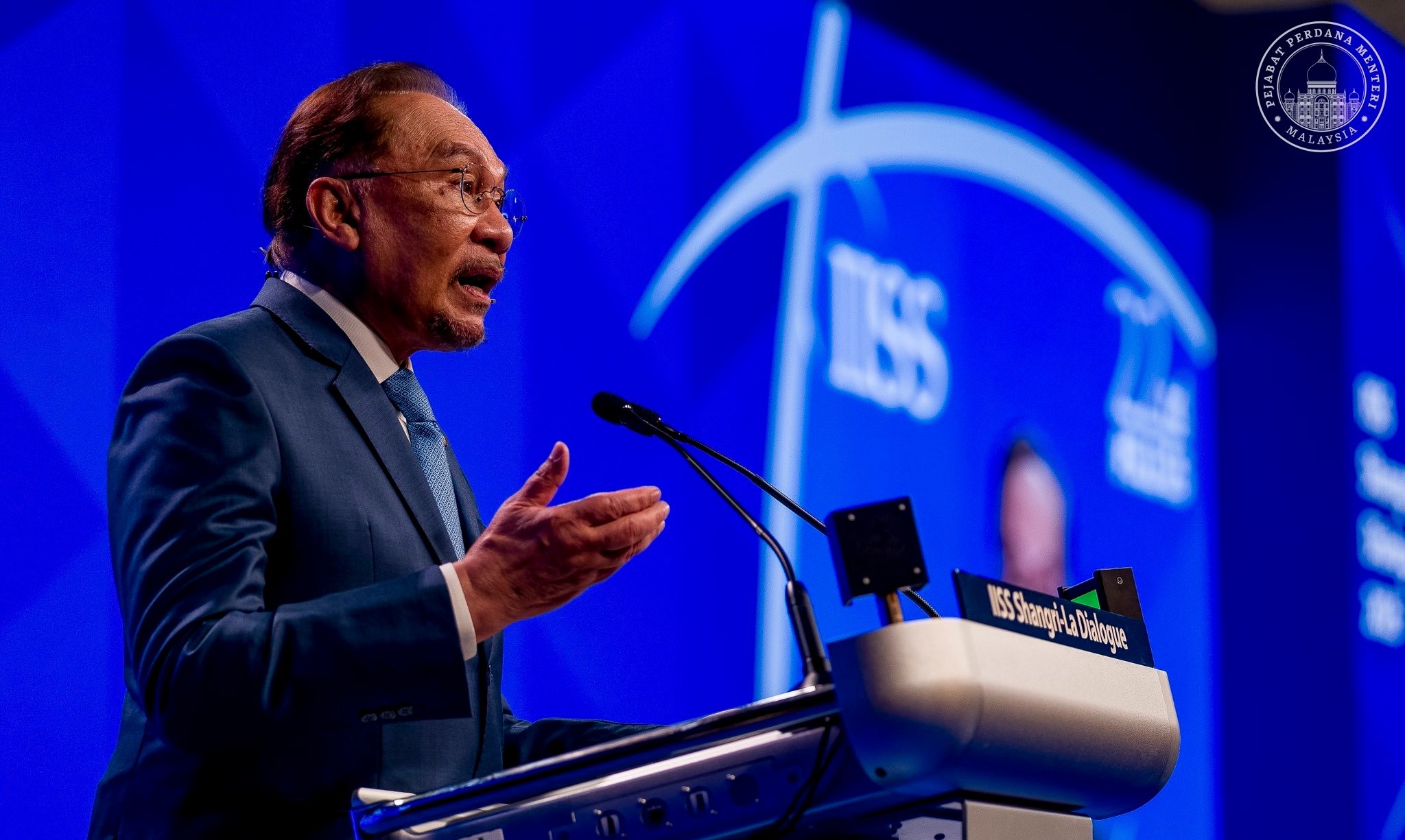

KUALA LUMPUR – Prime Minister Datuk Seri Anwar Ibrahim has renewed calls for calm in the South China Sea, warning that rising tensions among claimant states risk spiralling into confrontation in waters critical to regional security and prosperity.
“We have no interest in seeing tensions spiral into confrontation – least of all in waters so critical to our own security and prosperity,” he added.
“We will urge restraint, encourage dialogue, and work to preserve the stability on which this region depends,” he said in a keynote address at the 22nd Shangri-La Dialogue in Singapore today.
Anwar reiterated Malaysia’s firm insistence that all parties uphold the United Nations Convention on the Law of the Sea (UNCLOS), stressing that stability must be rooted in openness, transparency, and “habit-forming cooperation”.
He cautioned against the formation of coalitions that fuel arms races or revive the logic of spheres of influence.
“We do not object to like-minded partners talking amongst themselves. However, coalitions that build walls instead of bridges, stoke arms competition, or undermine the legitimacy of multilateralism should give us pause,” he said.
As Asean chair in 2025, Malaysia, he said, is committed to defending the bloc’s centrality and non-alignment.
“Preserving our autonomy is not about resisting others. It is about strengthening ourselves.”
Turning to Myanmar, Anwar said Asean is not passive on the crisis and remains firm on the Five-Point Consensus.
“Myanmar’s nationhood must be forged through inclusion, not erasure,” he said.
He stressed that Asean was never meant to dominate or dictate, but to foster peace through consensus, and pointed to the bloc’s latest summits as a reaffirmation of its relevance – with key developments including the Kuala Lumpur Declaration on Asean 2045 and steps toward Timor-Leste’s membership.
On Gaza, Anwar called on the international community to act decisively against what he described as genocide.
“We must not allow selective outrage or strategic fatigue to dull our moral clarity,” he said, adding that the failure of global institutions to stop the violence is a test of the world’s conscience.
“The scale of devastation, blatant disregard for humanitarian norms, and the inability of global institutions to effectively respond demand more than just expressions of sympathy.”
Anwar also rejected bloc politics in the wider geopolitical context, emphasising Malaysia’s strategy of engaging all major and middle powers – including the US and China – to preserve sovereignty and regional openness.
“This is a deliberate and strategic posture: to help preserve an open region, to assert our sovereignty, and to make our own choices – on our own terms.”
On the sidelines of the summit, Anwar met with US Defence Secretary Pete Hegseth and Boeing global president Brendan Nelson, with discussions centred on maritime security, defence cooperation, asset modernisation and investment in local education and industry.
“These meetings reflect Malaysia’s growing relevance in the regional and global defence landscape,” he said.
The Shangri-La Dialogue this year gathers 47 countries, including 40 ministerial-level delegates and over 20 defence chiefs. – May 31, 2025