

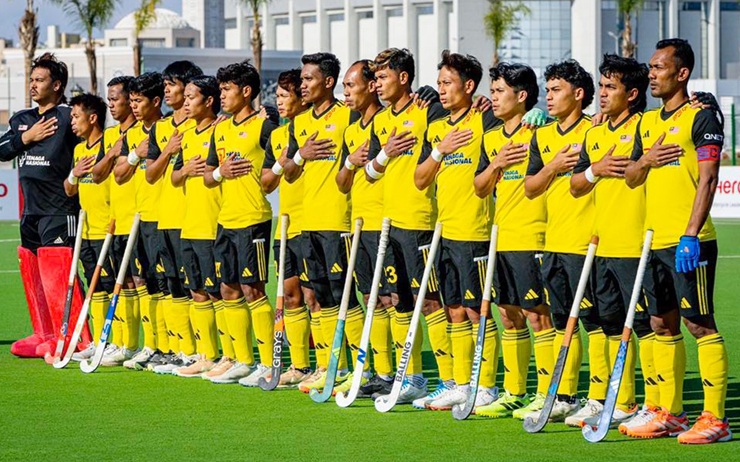
KUALA LUMPUR — Malaysia may have secured a ticket to the Men’s FIH Hockey World Cup in the Netherlands and Belgium this August, but let’s stop pretending it was some kind of triumph.
What happened in Egypt was not qualification through strength.
It was survival.
The Speedy Tigers stumbled through the World Cup Qualifiers in Ismailia looking less like a team preparing for hockey’s biggest stage and more like one desperately clinging onto it.
Under Sarjit Singh, Malaysia managed just two wins from five matches, finished fourth and conceded a worrying 22 goals while scoring 19.
Those numbers do not reflect progress. They scream vulnerability.
And the campaign ended exactly the way it deserved to – in painful fashion.
Malaysia threw away a comfortable 3–1 lead against Japan in the third-place playoff before collapsing to a 5–4 defeat.
If that was not embarrassing enough, the semi-final humiliation was worse.
England dismantled the Speedy Tigers 7–1 in a one-sided thrashing that exposed just how far Malaysia has fallen behind the world’s elite.
That scoreline should set off alarm bells across Malaysian hockey.
Because right now, the Speedy Tigers are nowhere near the level required to compete at the top.
Yet Malaysia will still be at the World Cup and not because they dominated the qualifiers, but because their world ranking of No. 15 kept the door open.
Technically, it counts as qualification.
But morally and competitively, it raises serious questions.
Simply qualifying should never be the benchmark for Malaysian hockey.
This will be Malaysia’s ninth appearance at the Men’s FIH Hockey World Cup, having previously competed in 1973, 1975, 1978, 1982, 1998, 2002, 2014 and 2018.
The nation’s proudest moment came in 1975 when Malaysia finished fourth on home soil and proved they could stand shoulder to shoulder with the world’s best.
Back then, Malaysia was widely recognised as Asia’s second-strongest hockey nation behind India.
Today, that reputation has faded badly and Malaysia now trails not only India but also Pakistan and Japan in the world rankings.
The slide has been gradual, but the warning signs are now impossible to ignore.
The qualifiers in Egypt exposed the same problems that have haunted this team for years.
The defence is fragile.
The goalkeeping is unreliable.
And the penalty corner conversion rate remains painfully poor.
Despite having legendary Pakistani drag-flicker Sohail Abbas involved in the coaching setup, Malaysia converted just eight of their 29 penalty corners during the qualifiers.
At the highest level of hockey, that statistic alone can decide matches.
Elite teams punish inefficiency.
Malaysia simply wastes it.
Sarjit may have technically achieved his mission by guiding Malaysia to the World Cup, especially after he earlier vowed to step down if the team failed to qualify.
He may have saved his job.
But qualification alone cannot be his legacy.
Because if the same problems persist in August, the consequences could be brutal.
England’s 7–1 demolition might not be an isolated humiliation.
It could be a preview.
At the World Cup, Malaysia will face teams that are faster, sharper and far more ruthless.
Teams that punish every defensive lapse.
Teams that convert every penalty corner.
Teams that will not hesitate to run up the score.
Unless drastic improvements are made in the next five months, Malaysia risks arriving at the World Cup not as challengers but as easy prey.
The national players will return to domestic action in the Malaysia Hockey League, starting April 1 before regrouping for the FIH Nations Cup in New Zealand in June.
Those tournaments cannot be treated as routine preparation.
They must become a period of urgent repair.
Sarjit does not just need to prepare this team. He needs to fix it.
Because if nothing changes before August, Malaysian hockey could be walking straight into another painful reminder of how far it has fallen.
Qualifying for the World Cup should never be the end goal.
For a nation with Malaysia’s hockey history, simply being there should never be considered success.
Right now, however, that is exactly what it feels like.
And if the Speedy Tigers are not careful, the World Cup will not remember them as competitors.
Only as participants. – March 10, 2026
Sandru Narayanan is a journalist at Scoop.my and also a passionate fan of Malaysian Hockey