

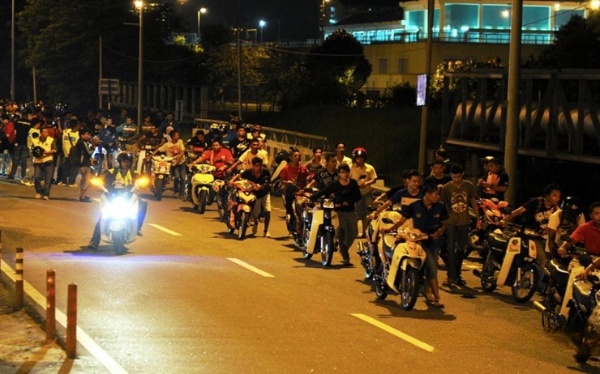
MALAYSIA’S road safety problem is often described in moral terms are “attitudes”, “awareness”, “education”. That framing is now obsolete. The data show a structural enforcement failure that is most lethal for one group: motorcyclists. When roughly two-thirds of road deaths involve two-wheelers and fatal motorcycle crashes on expressways have passed the four-figure mark annually, we are no longer dealing with isolated behavioural lapses but with a systemic governance gap.
1. Federal Highway: A RM20 million case study in misaligned incentives
The Federal Highway is a textbook example of how infrastructure without enforcement fails to deliver outcomes. The government has allocated RM20 million to upgrade the motorcycle lane along the Federal Highway (FT002), including resurfacing, safety improvements and extensive solar-powered LED lighting to address legitimate concerns about visibility and security. The project is explicitly justified on safety grounds and is designed to benefit an estimated 35,000 motorcyclists who use the corridor daily.
From a policy perspective, this is rational capital spending, separate high-vulnerability road users from heavier, faster vehicles on one of the country’s busiest arteries. However, the on-the-ground reality suggests a classic “implementation deficit”. Despite the investment, a significant proportion of riders continue to use the main carriageway, often at speed and in close proximity to lorries and buses. In economic terms, we have created a safe asset but allowed users to opt back into a riskier equilibrium with no meaningful penalty.
The cost of this misalignment is visible in national fatality data. Motorcyclists and pillion riders routinely account for around 69–70% of all road crash fatalities in Malaysia, far above their share of traffic volume. Fatal motorcycle crashes on expressways alone have reportedly risen from the 800-plus range to more than 1,000 deaths a year within a few reporting cycles, a jump of over 30%. These are not marginal fluctuations; they are structural trends that undermine the rationale for large-scale infrastructure spending if behaviour remains unchanged.
The logical policy response is straightforward:
– Regulatory clarity: Codify compulsory use of the dedicated motorcycle lane on the Federal Highway except where temporary diversions are clearly signposted.
– Enforcement architecture: Deploy fixed and mobile enforcement (cameras at entry/exit points, random spot checks) with predictable penalties for non-compliance, rather than episodic “operations”.
– Outcome monitoring: Link enforcement KPIs to specific indicators, motorcycle-involved crashes and fatalities on the main carriageway, and publish performance data periodically.
Without this enforcement ecosystem, the RM20 million allocation risks becoming a sunk cost that delivers political optics but limited safety dividends. If the Federal Highway is to be more than a statistical feeder to funeral homes, Malaysia needs to stop treating motorcycle safety as a matter of “awareness” and start treating it as what the numbers already say it is: a hard enforcement and policy-design problem that will not solve itself.
2. Gig riders: Externalised risk in a high-velocity labour market
The rise of platform work in transport and delivery has introduced a new layer of risk that traditional regulatory models have struggled to absorb. Social security and occupational safety statistics point to a sharp deterioration in outcomes in a short span of time. In one key scheme focused on self-employed and platform workers in goods and passenger transport, reported cases jumped by roughly 158–160% year-on-year, from the low-hundreds to nearly 2,000 cases. This is not organic background noise; it is a signal of systemic stress in a rapidly expanding labour segment.
At the macro level, commuting accidents are now a dominant component of occupational risk. In a recent year, over 70,000 accidents were recorded among insured workers, with commuting cases representing about 45–46% of the total. Crucially, commuting deaths (in the 600-plus range) more than double fatalities from industrial accidents at the workplace (just under 300 in the same period). The most dangerous “workplace” in Malaysia is increasingly the road, not the factory floor or office.
Platform economics help explain this pattern. The rider’s income is tied to volume and speed, while platforms compete on delivery times and reliability. Without strong external constraints, the rational response for many riders is to compress time by breaching traffic rules: beating lights, lane-splitting aggressively, riding against traffic and encroaching on pedestrian space. The risk is largely externalised – to other road users, pedestrians, and the public health system.
A policy-wonk answer requires moving beyond moral exhortation to structural levers:
– Automated enforcement at critical nodes: Install signal-controlled junction cameras in high-incidence urban corridors with clear evidentiary standards for motorcycle and gig-rider violations (especially red-light running).
– Platform-linked liability: Where riders are registered with platforms, summonses should be digitally linked to their platform IDs. Platforms can be made jointly responsible for fine recovery and mandated to implement a graduated sanction regime (warning, suspension, termination) based on repeated violations.
– Integrated data sharing: Create a data-sharing protocol between law enforcement, social security agencies and platform regulators so that high-risk patterns (e.g. clusters of crashes or violations linked to specific areas or companies) can inform targeted interventions.
This approach reframes gig-rider non-compliance as a problem of incentive design and regulatory reach, not merely individual irresponsibility. It also aligns with broader occupational safety principles: if commuting risk now kills more workers than industrial processes, enforcement and policy attention must follow the risk, not tradition.
3. Mat Rempit: Risk-seeking behaviour and enforcement elasticity
Illegal Street racing and mat rempit activity represent an acute, concentrated form of motorcycle risk that combines sensation-seeking psychology with enforcement gaps. Research on motorcycle street racers in Malaysia highlights high sensation-seeking traits and deliberate risk-taking, often reinforced by group dynamics and social recognition. From a governance perspective, this is a classic “high-harm, low-probability” challenge that can be significantly shaped by enforcement elasticity – how responsive behaviour is to perceived enforcement intensity.
Recent episodes illustrate both the scale of harm and the leverage of enforcement. In one coastal highway incident, an illegal rempit race ended with four riders dead and three critically injured in a single early-morning crash. In another widely reported case, 13-year-old teenagers became casualties in rempit-related incidents, indicating diffusion of the subculture into younger age groups. In some districts such as Sungai Buloh, fatal motorcycle crashes over a comparable period more than doubled, with deaths rising in tandem.
Yet when enforcement is ramped up and sustained, the behaviour responds. In a six-month enforcement window, operations targeting illegal racing produced over a thousand arrests, more than 20,000 summonses and around 2,200 vehicle confiscations. In at least one state, police subsequently reported that organised illegal street racing had effectively been suppressed following sustained post-tragedy operations. This suggests that rempit behaviour is highly sensitive to perceived enforcement certainty and visibility.
The policy implication is that current practice, periodic, highly publicised “ops” followed by long periods of relative laxity is sub-optimal. A data-driven enforcement regime would:
– Map hotspots and temporal patterns: Use crash data, complaints, and patrol reports to identify high-risk corridors and time bands for illegal racing.
– Normalise sustained operations: Treat anti-rempit enforcement as a permanent fixture in policing plans, with continuous patrol presence, not episodic crackdowns. Form a Rempit unit in the police.
– Deploy asset-based deterrence: Systematically confiscate and, where lawful, dispose of heavily modified bikes used in illegal racing, increasing the economic cost of participation.
The key is to shift perceived enforcement from “occasional and avoidable” to “continuous and unavoidable”, thereby altering the risk-reward calculus of potential offenders.
4. From campaigns to governance: A multi-agency enforcement architecture
Across these three domains – Federal Highway Lane usage, gig-rider risk and mat rempit activity, the pattern is consistent: the constraints are not conceptual or infrastructural, but institutional. Malaysia has the legal provisions, the agencies and, in some cases, the specialised infrastructure. What it lacks is a coherent enforcement architecture anchored in shared data, clear accountability and outcome-oriented metrics.
A serious response would include:
– A permanent road-safety enforcement task force chaired by the police and including JPJ, local authorities, Miros, social-security agencies and platform regulators. This body should be explicitly mandated to reduce motorcycle-related deaths and commuting fatalities and report annually on progress.
– KPI realignment: Move beyond activity-based metrics (number of roadblocks, number of campaigns) to outcome-based indicators: motorcycle deaths per 100,000 population, expressway motorcycle fatality trends, commuting death ratios, and prevalence of serious violations (e.g. red-light running).
– Transparent data publication: Regularly publish disaggregated data on motorcycle crashes, gig-rider incidents and illegal racing enforcement outcomes to enable independent scrutiny and policy feedback.
In governance terms, the central argument is simple: where the risk is highest, enforcement must be most predictable, coordinated and data-driven. Right now, the inverse often holds. We have poured money into lanes that are not consistently used, tolerated business models that implicitly reward dangerous shortcuts, and treated mat rempit as a seasonal headline rather than a persistent public-safety threat.
If the Federal Highway is to be more than a statistical feeder to funeral homes, Malaysia needs to stop treating motorcycle safety as a matter of “awareness” and start treating it as what the numbers already say it is: a hard enforcement and policy-design problem that will not solve itself. – June 23, 2026
Ravindran Raman Kutty is an award winning PR practitioner