

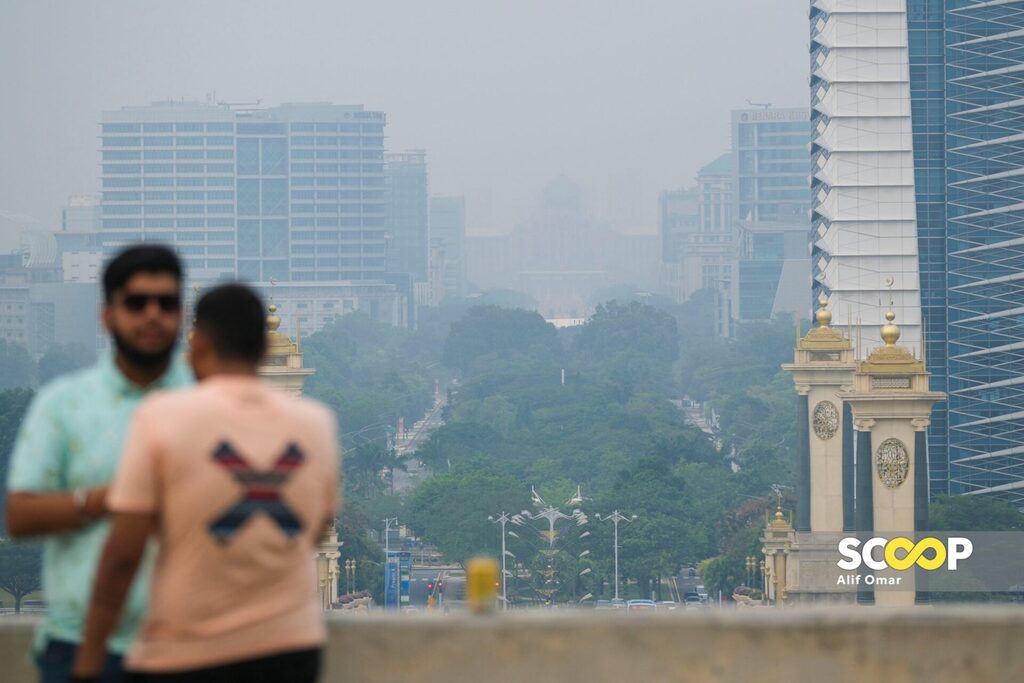
THE haze is back. Again. And once more, ordinary Malaysians are left staring at a grey sky, checking API readings on their phones instead of the weather, and wondering out loud why the people paid to protect us seem so unbothered by our suffering.
This is not a new story. It is an old, tired, insulting rerun. Since 1 August, a fresh wave of transboundary haze from land and forest fires in Sumatra and Kalimantan has settled over Malaysia, Brunei, Singapore and Thailand, in what is now being called the 2026 Southeast Asian haze crisis. On 21 August, Serian in Sarawak recorded an Air Pollutant Index reading of 242, deep into the very unhealthy band. As of this morning, ten areas across four states, from Serian and Kuching in Sarawak to Johan Setia in Selangor and Sungai Petani in Kedah, were still recording unhealthy readings, with not a single station in the country reporting good air.
Behind every one of those numbers is a grandmother struggling for breath, a toddler wheezing through the night, and a mother deciding whether it is safe to send her child to school. Nearly 600 schools in Sarawak, serving more than 197,000 pupils, were shuttered in a single week because the air outside was too dangerous to breathe. Our Health Minister, Datuk Seri Dr Dzulkefly Ahmad, has confirmed that asthma cases jumped by 259 percent and upper respiratory infections rose by 124 percent in one epidemiological week alone. This is on top of an unforgiving heat wave driven by El Nino, which our neighbour’s own weather agency says will not fully ease until early 2027. We are being cooked and choked at the same time, and told to be patient.
Patient for what, exactly. Indonesia’s own forestry ministry recorded 11,908 fire hotspots nationwide in a single 24 hour period in late August, nearly double the count from the day before. These are not accidental. Peat and forest do not set themselves alight year after year, always in the same dry season, always for the same purpose of clearing land cheaply. This is a business model that treats our air as a free dumping ground.
And what has our neighbourhood done about it. The region has had a legally binding instrument, the ASEAN Agreement on Transboundary Haze Pollution, since 2003. More than two decades on, researchers and legal scholars are unanimous: it contains no penalty clause and no enforcement mechanism whatsoever. Indonesia itself only ratified it in 2014, twelve years after it was signed. A landmark Harvard and Columbia study estimated the 2015 haze crisis alone caused more than 100,000 premature deaths across Indonesia, Malaysia and Singapore. One hundred thousand lives, and still no binding consequence for anyone.
So forgive us for asking, with all due respect but zero patience left: where is the outrage from our leaders that matches the outrage in our lungs. The 27th Sub Regional Ministerial Steering Committee met in Bali in July and “reaffirmed commitment” to a haze free ASEAN by 2030. Reaffirmed. Committed. These are the words of people talking in conference rooms, not people fighting fires. It was only this week, with Serian nearing very unhealthy levels for days on end, that Malaysia and Brunei finally agreed to formally invoke the ASEAN mechanism. Why does it always take a crisis already at its worst before anyone in a suit picks up the phone.
We host the world with pride. Our capital has welcomed heads of state and grand summits that put Malaysia squarely on the global stage. Yet the same regional grouping that can roll out red carpets for visiting dignitaries cannot, after twenty three years, produce a haze agreement with teeth. Someone must ask the uncomfortable question out loud: who exactly will bell the cat. Are we condemned forever to bilateral pleading, polite letters, and reaffirmed commitments, while real people pay in hospital bills, missed school days, and shortened lives.
There are small signs of movement. Indonesia has finally allowed Malaysian aircraft to conduct cross border cloud seeding along the frontier this week, a genuinely welcome step. Jakarta has also arrested 72 suspects linked to forest and land burning and says it will trace the financiers behind the fires, not only the workers who light the matches. These deserve acknowledgment. But we have seen this movie before, in 2015 and 2019. Companies get named, licences get suspended, lawsuits get filed, and then a court quietly dismisses the case, and the cycle resets the following August.
What we are asking for is not complicated. We want an ASEAN haze mechanism with actual penalties, not reaffirmed statements. We want our own government to treat every haze season as a public health emergency requiring immediate cross border enforcement demands, not quiet diplomatic notes sent after the API has already crossed 200. And we want our leaders, when they sit at those grand tables with the powerful of the world, to remember that the people who elected them are the same people standing outside in masks, counting the days until they can breathe freely again.
Clear skies should not be a matter of luck or wind direction. They should be a promise our leaders keep. Until then, every unhealthy reading on the API is not just a number. It is an accusation. – Sept 1, 2026
Ravindran Raman Kutty is an award winning PR practitioner