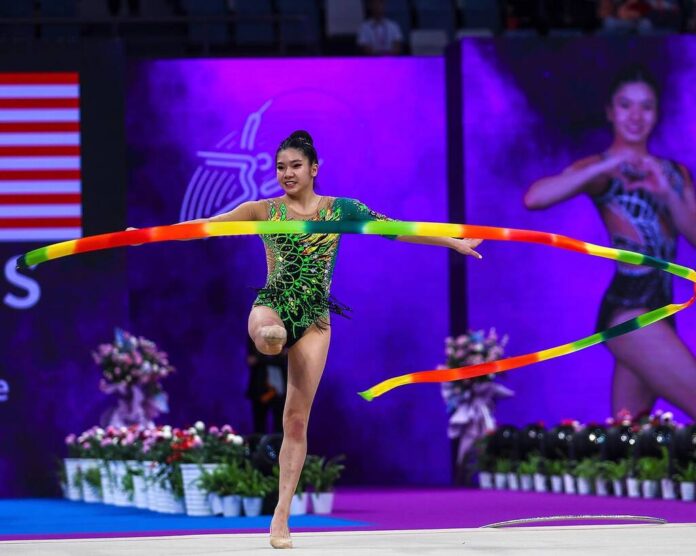
KUALA LUMPUR — The Malaysian Gymnastics Federation (MGF) must explain why Malaysia was not represented at this year’s Rhythmic Gymnastics World Championships, with senior sports analyst Datuk Dr Pekan Ramli questioning how the discipline can be regarded as a core high-performance sport when its athletes are not given consistent exposure to major international competitions.
Speaking to Scoop, Pekan said rhythmic gymnastics should be treated as a priority under the country’s high-performance sports programme, particularly because most athletes are young and have relatively short competitive careers.
“I am not sure what the issue is. Is it a financial issue or a matter of funding and allocations? Or is there another issue involved? Rhythmic gymnastics is listed as one of the core high-performance sports. Therefore, there should not be any issue about this sport not being regarded as a priority within the country’s high-performance sports programme,” he said.
The 42nd Rhythmic Gymnastics World Championships were held in Frankfurt, Germany, from Aug 12 to 16, with organisers stating that 350 gymnasts from 73 countries competed.
Germany’s Olympic champion Darja Varfolomeev won the individual all-around title for a third consecutive time and finished the championships with three gold medals.
Malaysia, however, had no representative at the event.
Pekan said that if Malaysia’s talent development programme was being properly planned, young gymnasts should be given consistent exposure to international competitions, including World Cups.
“If all the development plans to nurture and advance talent in this sport are properly and systematically implemented, then these athletes should be given consistent and continuous exposure to various international competitions, including World Cups.
“If a competition does not impose qualifying standards or ranking requirements for participation, then we should certainly make full use of that opportunity,” he said.
He said such exposure would provide young athletes with valuable experience, helping them mature more quickly and develop the confidence needed to compete at regional and Asian level, while improving their prospects of eventually qualifying for the Olympic Games.
Pekan warned that Malaysia could not afford to leave its athletes underexposed internationally and then expect them to compete against stronger rivals at major Games.
He pointed to the danger of Malaysian gymnasts being overtaken by athletes from neighbouring countries, as happened at the 2025 SEA Games in Thailand.
The Universiti Teknologi MARA (UiTM) Faculty of Sports Science and Recreation senior lecturer stressed that the issue was particularly important because many of Malaysia’s rhythmic gymnastics talents are teenagers, while their careers are relatively short.
He said athletes needed exposure to different competitions from a young age, when their flexibility and technical abilities could still be developed and refined.
“If any of these young athletes become disappointed and eventually withdraw or quit halfway through their careers because of our failure to properly plan a talent development programme for the sport, then it would be better to remove gymnastics or rhythmic gymnastics from the list of core high-performance sports for the 2025-2028 period,” he said.
Meanwhile, senior sports analyst and UiTM sports science lecturer Sadek Mustaffa said MGF also needed to answer questions over Malaysia’s absence from the World Championships, stressing that funding was not the issue.
Sadek said the fact that rhythmic gymnastics was not contested at the 2026 Commonwealth Games in Glasgow did not provide sufficient justification for Malaysia to overlook the World Championships.
He acknowledged that breaking into the top 10 would have been difficult given the dominance of athletes from Eastern Europe and Russia, but said the association still needed to explain its decision.
“At the same time, the team is preparing for the Asian Games, where our rhythmic gymnasts have a better chance of winning medals. In terms of the athletes’ standard at world level, our athletes are still some distance behind the major powers in rhythmic gymnastics,” he said.
Sadek said participation at the World Championships depended heavily on the national association’s recommendations and the blueprint it submitted to the National Sports Council (NSC).
He added that MGF needed to explain why athletes were not sent if funding was available.
“If there are no athletes who can meet the required standards, then it is naturally difficult for them to go to the World Championships. Funding is not the issue because allocations for that are already available. It is the national gymnastics association that needs to answer regarding this matter,” he said.
He said Malaysia needed a long-term blueprint covering three Olympic cycles, with talent identification beginning well before SUKMA through MSSM competitions and under-12 and under-15 programmes.
He also called for national rhythmic gymnastics carnivals, which have become less active since the Covid-19 pandemic, to be revived.
Sadek said this would require close cooperation between the NSC, Olympic Council of Malaysia (OCM), MGF, MSSM and sponsors to create a clear pathway for athletes from grassroots level through junior and senior competitions, the World Championships and eventually the Olympics.
He also warned that Malaysia’s traditional strength in rhythmic gymnastics at the SEA Games could come under threat, with Singapore closing the gap.
At the same time, he said Malaysia’s talent pool was becoming increasingly smaller as the sport remained concentrated in major urban areas.
Ultimately, the issue goes beyond Malaysia’s absence from one World Championships, with the bigger question being whether MGF and the country’s high-performance system are providing young rhythmic gymnasts with the competition exposure and development pathway needed to progress towards the Asian Games, World Championships and Olympics.
Scoop has contacted MGF president Kau Git Kaur for comment and is awaiting his response. — September 3, 2026