

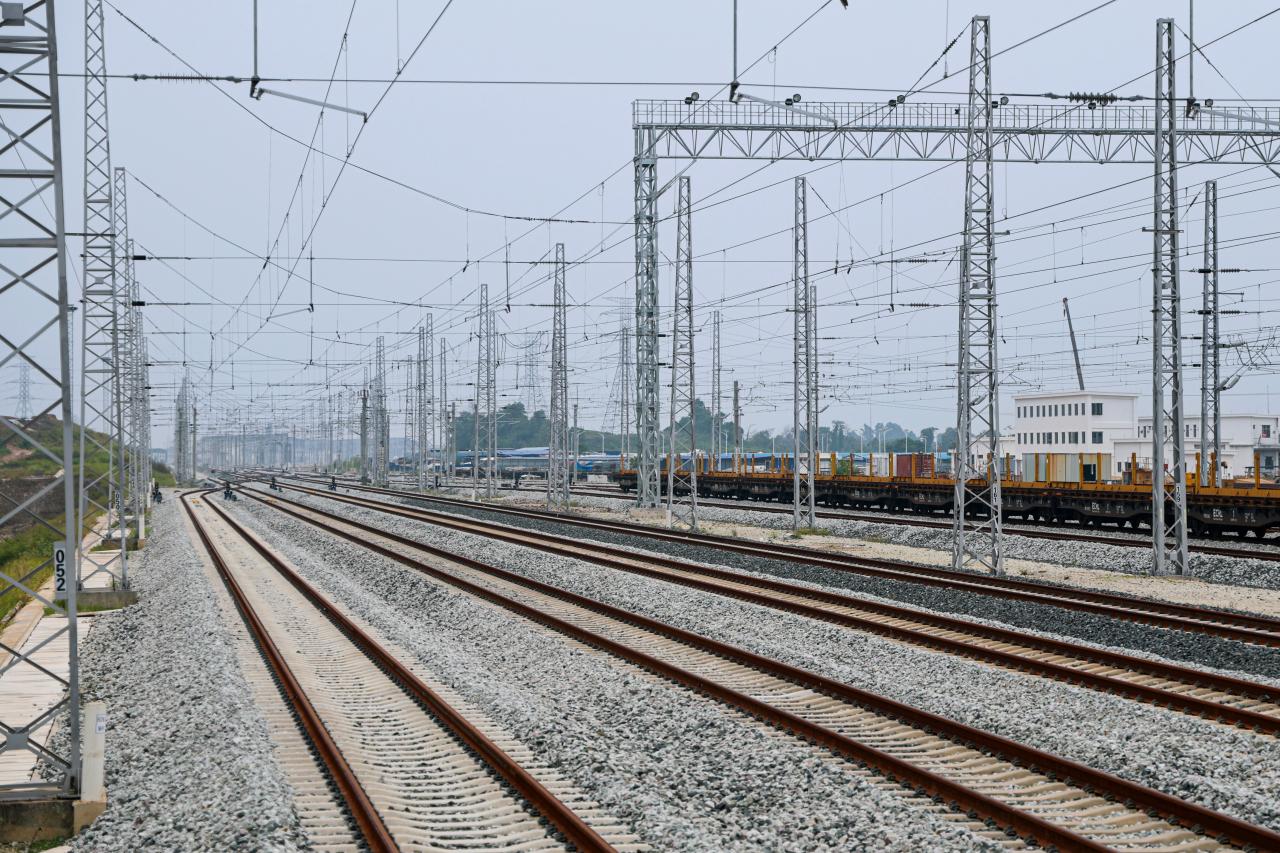
Four Train-the-Trainer, (TTT) courses will be conducted in Malaysia by Chinese master trainers from Liuzhou Railway Vocational Technical College, LRVTC, covering Railway Passenger Service, Railway Freight, Railway Power Supply Systems and Railway Signalling Systems.
This first phase will establish the foundation for Malaysia’s Regional Rail Standards and Training Centre of Excellence, RCoE, while building local trainer capacity for ECRL and the wider rail sector.
On 29 September, in my capacity as Chairman of the Executive Committee on TVET Internationalisation and Strategic Cooperation under the National TVET Council, I led a delegation comprising ECRL Operations Sdn Bhd, EOSB, and the Malaysia Rail Development Corporation, MRDC, on a two-day working visit to Liuzhou, Guangxi Zhuang Autonomous Region, China.
Our discussions focused on the joint establishment of a Regional Rail Standards and Training Centre of Excellence, RCoE, and the implementation of related rail talent development programmes. The discussions produced substantive outcomes and detailed agreement on several key areas.
Through the RCoE, we aim to train rail technical professionals for Malaysia and other ASEAN countries. We also want the Centre to serve as a platform to bring international rail technologies, standards and expertise into Malaysia, address our long-standing shortage of specialised rail talent, and support Malaysia’s ambition to develop into a regional rail hub.
During his recent meeting in Beijing with Song Xiude, Administrator of China’s National Railway Administration, while attending the APEC Transport Ministers’ Meeting, Malaysia’s Minister of Transport also expressed Malaysia’s intention to further deepen Malaysia-China rail cooperation and jointly establish the Regional Rail Standards and Training Centre of Excellence in Malaysia.
The Ministry of Transport has mandated MRDC to drive and implement the RCoE. I have also been tasked with coordinating with our Chinese counterparts on the Centre’s first-phase implementation project, namely the initial Train-the-Trainer, TTT, programme for ECRL to be conducted in Malaysia.
Since June this year, both sides have been exchanging information and working through the implementation framework for the RCoE and the TTT programme.
On 29 September, following almost five hours of discussions and negotiations, we reached an agreement in principle to proceed with the first four training programmes. Liuzhou Railway Vocational Technical College, LRVTC, agreed to arrange for its relevant lead master trainers to travel to Malaysia within this year to conduct the first phase of training.
The four priority training areas are:
1. Railway Passenger Service
2. Railway Freight
3. Railway Power Supply Systems
4. Railway Signalling Systems
The principal training activities under the Rail Centre of Excellence are planned to be anchored at the Malaysia Rail Academy, MyRA, in Batu Gajah, Perak, supported within the wider rail training ecosystem involving Keretapi Tanah Melayu Berhad, KTMB, and the Railway Assets Corporation, RAC.
The Malaysian and Chinese parties are also working towards the signing of a Memorandum of Understanding during the World Vocational and Technical Education Development Conference in Tianjin from 15 to 18 October. Our discussions in Liuzhou also covered the substance of this proposed MOU and the framework for subsequent cooperation.
Following our return to Malaysia, EOSB and MRDC will jointly develop a comprehensive training matrix. This will map course requirements, curricula, trainers, participant intake, manpower, equipment and training facilities. We will also distinguish between programmes suitable for TTT and those suitable for direct delivery to trainees, before setting priorities based on actual industry needs and moving quickly into implementation.
This process will also open the way for broader cooperation with LRVTC and other international rail training institutions.
My position throughout these discussions has been clear.
The purpose of this cooperation is to ensure that professional capability, curricula, skills standards and certification capacity are genuinely retained in Malaysia through Malaysia-China rail talent cooperation.
Rail is our starting point. Our objective is to build the RCoE into a long-term talent platform serving Malaysia’s transport sector, and progressively develop it into a regional hub for TVET, skills certification and professional training for ASEAN.
Major infrastructure projects should leave behind more than railways, stations and equipment. They should leave behind technology, talent, standards and local capability.
This visit produced practical consensus and concrete outcomes that can move immediately into implementation. It also reaffirmed several important principles.
First, talent development must respond directly to the present needs of industry, the market, the nation and the people, while also preparing for Malaysia’s future development needs.
Second, genuine technology transfer must begin with skills transfer. Localising trainer development must be the starting point for building independent technical capability and enabling long-term technology transfer.
Third, Malaysia’s rail development should progress from simply “learning Chinese standards in China” towards “Malaysia and China working together to develop rail standards with wider regional applicability.”
These principles reflect a broader shift in thinking and mark a new push for the next stage of rail reforms under the leadership of the Minister of Transport, Anthony Loke Siew Fook: sovereignty, skills and synergy.
Sovereignty means ensuring that Malaysia retains the capability, knowledge and institutional strength to manage and develop its own rail systems. Skills means building a strong pipeline of local trainers, technicians, professionals and leaders. Synergy means bringing together government, industry, training institutions and international partners to achieve outcomes that no single party can deliver alone.
This is how international cooperation should work. It should build capability in Malaysia, strengthen our own institutions, and create the foundation for Malaysia to contribute rail talent, skills and standards to the wider region. – October 3, 2026
Howard Lee is the chairman of the TVET Internationalisation and Strategic Collaborations Executive Committee of the National TVET Council and Ipoh Timor MP