

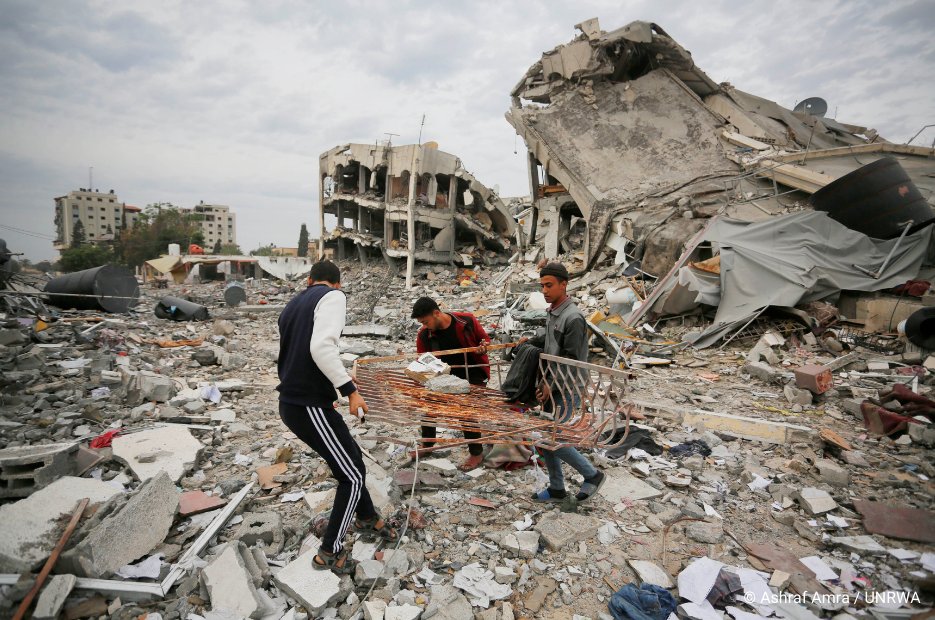
THE recent and fully predictable resumption of the conflict between the United States against Iran should put to rest once and for all that the Middle East and particularly the Strait of Hormuz will be locked into a long-term, open-ended conflict driven in part by President Donald Trump and the US establishment that is desperately seeking to hinder the development of a multipolar world.
The US has no military capacity to invade Iran and indeed that is not the objective. As we saw with Trump’s global tariff campaign this year and at least two conflicts aimed at disrupting the flow of energy, namely oil and gas, but also a whole range of key commodities including fertilisers, helium, urea and other critically important materials, the US is seeking to shatter supply chains across Eurasia in the hopes of taking advantage of this situation and drag out its tortured demise as the global hegemon.
This “rolling conflict” that spans Russia, Iran and parts of Latin America will eventually come to ASEAN, the South China Sea and the Taiwan strait as the US seeks to confront China, its only real peer competitor, and the US will seek to destabilise, disrupt and destroy the supply chains, economic links and development potential of East Asia.
Era of hedging is over
For decades, Southeast Asia has treated maritime chokepoints like the Strait of Hormuz as immutable, open arteries of global commerce. That era is over. The fragmentation of global trade is no longer a temporary logistical headache; it is the permanent operational reality for the short and medium term. ASEAN states can no longer afford to wait and hope for a definitive end to the current maritime disruptions. The Trump administration has signaled a determination to sustain an open-ended engagement over these waterways, turning the Strait of Hormuz into a permanent theater of geopolitical leverage rather than a secure trade route.
In July 2026, President Trump went so far as to announce unilateral 20 percent cargo fees on all commercial vessels passing through the strait. This highly disruptive – not to mention barely doable – tariff proposal, combined with recurrent U.S. Central Command strikes in the region, confirms that relying on the maritime status quo is a strategy of diminishing returns.
Looking inward and landward: the Eurasian shift
Faced with highly vulnerable maritime routes, ASEAN must fundamentally reorient its logistics and supply chains. The solution lies in doubling down on integration with the Eurasian continent. At the June 2026 plenary session of the ASEAN-Russia Commemorative Summit, regional leaders explicitly agreed to strengthen connectivity between ASEAN and the Eurasian Economic Union (EAEU).
By expanding robust land and air links with major continental trading partners – specifically Russia, India, and China – the region can insulate its supply networks from the volatility of distant waters. Maximising the potential of strategic transport corridors like the International North–South Transport Corridor (INSTC) and trans-Asian railway networks is no longer an alternative but an economic necessity. Rather than acting as passive consumers of maritime security provided by outside powers, Southeast Asian nations need to actively invest in continental infrastructure that bypasses traditional chokepoints entirely.
Closer to home, the China-led Belt and Road Initiative (BRI) has seen the construction of key trade routes including ports, railways, inland ports and air-links, most of which pass overland across Eurasia and in theory are immune to US maritime intervention. Naturally the US is working hard to politically capture certain states in an effort to disrupt these links. It has also worked hard to destabilise Chinese built trade networks like the China-Pakistan Economic Corridor (CPEC). ASEAN must not assume that similar efforts will not be carried out in Southeast Asia, with the Malacca Strait being particularly vulnerable.
Cost of division – lessons from distant theaters
To survive this fractured landscape, ASEAN must guard its internal unity with absolute resolve. Foreign powers with interventionist intentions will continuously seek to divide or fragment the grouping to serve their own strategic ends. The consequences of such divisions are already on vivid display globally.
In Latin America, regional fragmentation left Venezuela isolated, culminating in political destabilisation and direct attacks on its maritime sector. Meanwhile, the Middle East offers a harsher warning: certain Arab states hosting U.S. forces have found themselves on the receiving end of severe Iranian retaliatory strikes. If ASEAN allows its members to be pulled into competing spheres of influence, it risks importing these exact kinetic vulnerabilities to its own doorstep.
Neutrality through total integration?
The only defence against external encroachment is a deeper, more comprehensive domestic cohesion. ASEAN must rapidly scale up its internal commitments far beyond standard tariff reductions. True resilience requires redoubling regional integration across critical vulnerabilities: building a shared, interconnected regional power grid, securing collective food and agricultural supply chains, and deepening defence and security cooperation. The launch of the ASEAN Plan of Action for Energy Cooperation (APAEC 2026–2030) and the Enhanced ASEAN Power Grid initiative show that the bloc recognises the urgency of multilateral integration. Upgrading cross-border infrastructure to enable efficient energy and agricultural trade will turn the region into a self-reliant economic fortress.
By thickening these internal bonds, the bloc can maintain its core principles of strict neutrality and ASEAN centrality. The grouping must ensure there is absolutely no opening, foothold, or institutional support for external conflicts within its borders. Southeast Asia’s future cannot be left to the mercy of blockaded straits – it must be anchored in continental connectivity and unshakeable regional solidarity. – July 16, 2026
Dr Julia Roknifard is a Senior Lecturer at the Bachelor’s Program on Philosophy, Politics, and Economics at the School of Law and Governance, Taylor’s University (Malaysia)