

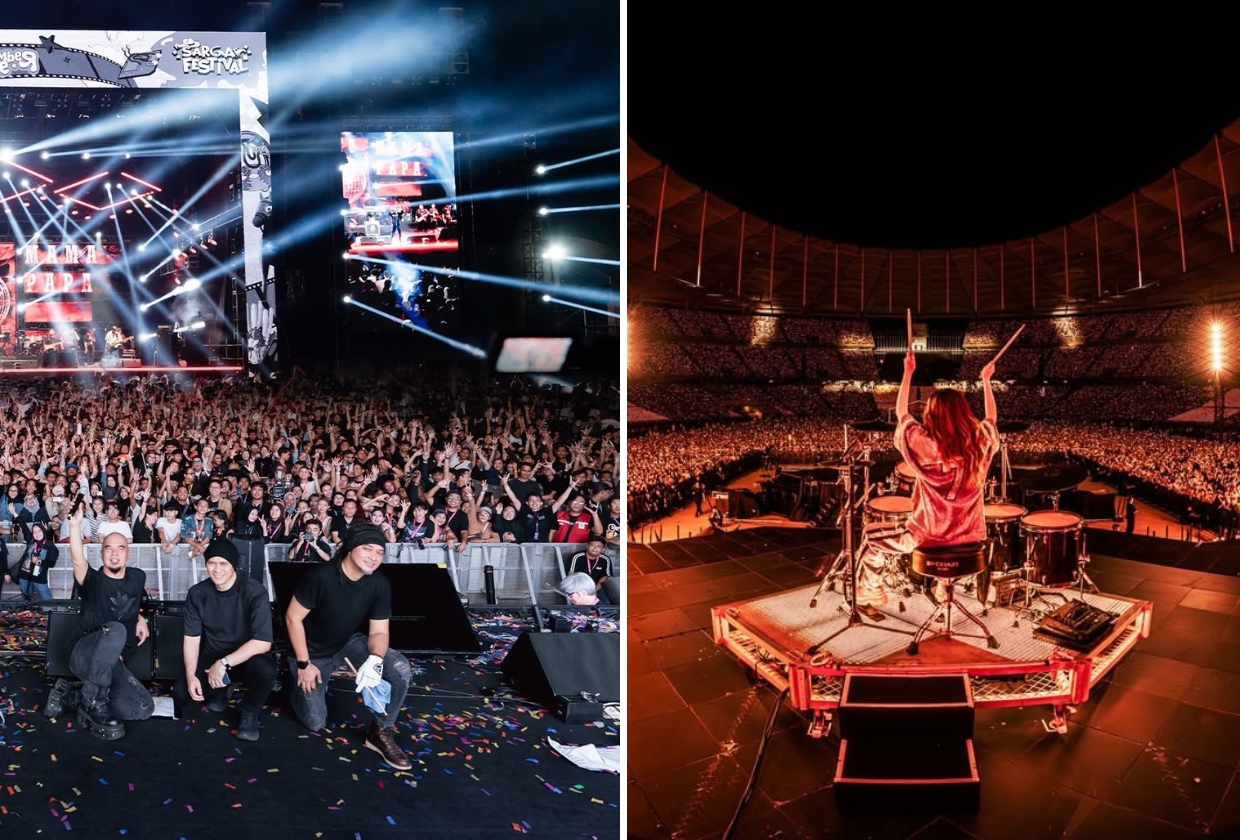
OVER the weekend, two venues in Bukit Jalil’s Kuala Lumpur Sports City (KLSC) pulsed with sound. At the Unifi Arena, Dewa 19 and Padi Reborn reunited two of Indonesia’s most beloved bands on one stage for the first time. A short walk away, the Cantopop powerhouse G.E.M. brought her I Am Gloria tour to the 87,000-seat TM National Stadium.
Tens of thousands of Malaysians and visitors from across the region converged on a single neighbourhood, on a single night, to do something profoundly ordinary and yet profoundly human: enjoy music together.
We should celebrate this. Not tolerate it, not merely permit it, but celebrate it.
Malaysia has quietly become one of Asia’s most attractive concert destinations, and the reasons are structural rather than accidental. We are peaceful and politically stable. We are affordable relative to Singapore and Hong Kong. We sit at the geographic centre of ASEAN, within easy reach of Jakarta, Bangkok and beyond. And in KLSC we possess genuinely world-class infrastructure: a national stadium that seats 87,000, an arena for 16,000, a national hockey stadium for up to 18,000.
These are all clustered in one precinct with transport connectivity built for crowds of national scale. This is precisely why ASM Global, the world’s largest venue operator, previously sought to make KLSC a flagship in its regional portfolio. The fundamentals are there. Event organisers know it; that is why our marquee venues are booked months, sometimes a year, in advance.
The numbers confirm the instinct. Malaysia’s live events industry contributed close to RM1.72 billion to the economy in 2025, hosting more than 450 concerts compared to 104 in 2022. Coldplay and Blackpink alone generated around RM201 million in combined economic activity in 2024. This is not loose change. It flows into hotels, restaurants, ride-hailing drivers, sound and lighting crews, security firms, retailers and the thousands of young Malaysians building careers in an industry that barely existed at this scale a decade ago.
But the economic case, compelling as it is, is not the part that drives me most.
We attend concerts that begin with Negaraku. I’ve seen bands baca doa before going up onto the stage. I watch crowds break away for Maghrib between the opening and main acts. In that crowd are women in tudung standing beside tattooed arms in tank tops, all singing the same chorus. Nobody flinches. Nobody polices anybody. All are united by the music and bound by a quiet, instinctive mutual respect.
That scene is Malaysia at its best; and it is something no other country in this region can quite replicate. It is not a weakness to be managed. It is a national strength to be defended. There will always be voices who would cancel a show, narrow what is permitted, and shrink the space in which Malaysians gather and celebrate. We should not surrender that space to the loudest and most fearful among us. A confident, plural Malaysia can host the world’s biggest acts and hold true to its values. We have proven it, repeatedly.
But if we are serious about this industry, two things must follow.
First, this cannot be a Western-centric story only. The fastest-growing demand is regional and Asian. Dewa and Padi filled an arena this weekend on nostalgia and shared language. G.E.M. filled a stadium. Tamil stars like Sid Sriram sell out. And the K-pop phenomenon operates on another plane entirely – witness the Army and Blinks.
We must build an ecosystem that captures this regional appetite while creating real opportunity for our own. Malaysian artists deserve the same stages, the same production values, and the same shot at regional audiences. An industry that only imports talent is a marketplace; one that also exports it is a culture.
Second, this requires a genuine partnership between government and the private sector as well as honesty about the trade-offs. As Chairman of Perbadanan Stadium Malaysia (PSM), the body in charge of KLSC, I am clear-eyed that our venues must be run on commercial terms. We must give event organisers certainty, competitive rates and professional service.
Section 4 of Act 717 mandates PSM to promote “multi-purpose venues for sports, recreational, cultural, educational, commercial and entertainment events and such other events as the Perbadanan thinks fit”.
We also carry a national responsibility: our stadiums must serve nation-building, which means balancing profitable entertainment with subsidies for sports events. The resolution of that tension is straightforward in principle. Commercial success funds public purpose. Profit earned from concerts will be reinvested directly into the venues in the form of more walkways, more toilets (cleanliness tends to correlate with availability), better prayer areas, and proper facilities for the athletes and artists who use these spaces. Commerce and stewardship are not in conflict; one pays for the other.
None of this happens through goodwill alone. The single biggest obstacle is not demand but friction. As the promoter Iqbal Ameer recently highlighted in a social media post, Malaysia should consider having a one stop centre for live events as opposed to having bureaucratic ping-pong between multiple authorities and ministries. As he puts it bluntly: “It’s exhausting (and it’s expensive).” He is right. Every avoidable week of uncertainty is a reason for a global tour to choose Singapore or Bangkok instead of us.
So the call to action is concrete. Improve the ease of doing business — ideally through a single, transparent approval pathway with published criteria and clear timelines. Promote Malaysia abroad as aggressively as our neighbours promote themselves. And let the public and private sectors build this ecosystem together, deliberately, rather than leaving it to chance.
We have the venues. We have the location. We have, in our own crowds, a model of pluralism the rest of the world struggles to achieve. What we need now is the resolve to back it.
The music is already playing. Let us make sure Malaysia does not lose the stage. – June 10, 2026
Dr Helmy Haja Mydin is Chairman of Perbadanan Stadium Malaysia