

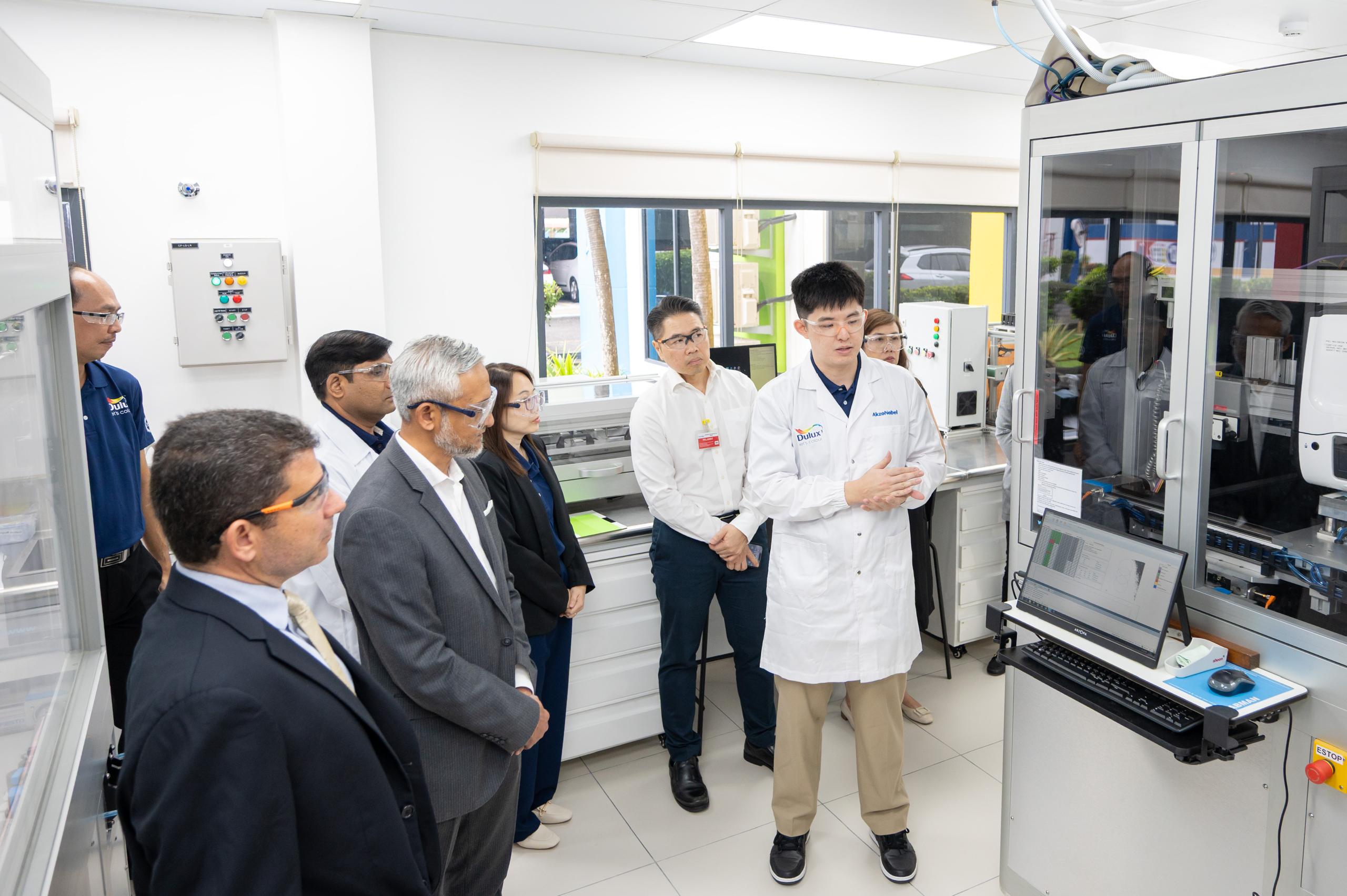

KUALA LUMPUR — AkzoNobel is ramping up sustainable innovation in Southeast Asia through its newly launched research and development centre in Nilai—an advanced hub designed to fast-track eco-friendly decorative paints across the Asean region.
Part of AkzoNobel’s global network of 70 R&D labs, the Nilai facility focuses on developing high-performance, sustainable paint formulations tailored to local climates and regulations, with cutting-edge tools and automation at its core.
“The newly launched research and development centre in Nilai is an important step forward in our commitment to innovation and sustainability,” said My Lan Nguyen, AkzoNobel’s business unit director for decorative paints in Asean.
“It focuses on developing advanced decorative paint technologies, with particular emphasis on eco-friendly and sustainable solutions that meet the evolving needs of consumers in the region.”
Strategically located near key markets like Indonesia, Thailand and Vietnam, the centre improves responsiveness to local demand and regulatory changes.
“This facility serves as a regional innovation hub, helping to bring our R&D capabilities closer to key Southeast Asian markets.
“By doing so, we can respond more quickly to local demands, climate conditions, and regulatory requirements,” Nguyen explained.
“As part of AkzoNobel’s global R&D network, the Nilai centre strengthens our ability to collaborate across regions and bring forward solutions that are both globally aligned and locally relevant for the Decorative Paints business.”
Central to the centre’s operations is a state-of-the-art robotic testing system that enables high-throughput, 24/7 experimentation. This boosts productivity, reduces material waste, and shortens development cycles.
“The robotic testing system at our Nilai R&D centre is a significant advancement in how we approach product development—especially when it comes to driving sustainable innovation,” Nguyen said.
“It can operate around the clock, which greatly enhances our overall efficiency and productivity.
“It helps reduce material waste, minimises energy consumption, and shortens development cycles—contributing directly to more environmentally friendly and efficient innovation practices.”

The facility is staffed by 35 R&D professionals, most of them from Malaysia, and benefits from close proximity to AkzoNobel’s local manufacturing and infrastructure.
“The Nilai R&D centre is powered by a team of 35 R&D professionals, with a strong emphasis on tapping into Malaysia’s local talent,” she said.
“By drawing on regional expertise and insights, we are better equipped to develop coatings that are truly tailored to Southeast Asian conditions—whether it’s extreme heat, heavy monsoons, or algae-prone environments.”
“Being located in Nilai’s industrial area places the centre close to our manufacturing operations and key infrastructure, which supports faster decision-making and smoother integration between R&D and business teams.”
Low-VOC and bio-based innovations are among the priorities, along with energy-efficient systems and eco-conscious construction.
“These principles are fully reflected in our new R&D centre in Nilai. The facility specialises in advanced decorative paint technologies, with a clear focus on eco-friendly solutions,” Nguyen said.
“Beyond its research capabilities, the Nilai facility was built with sustainability at its core.”
“To me, sustainable innovation in decorative paints means developing solutions that reduce environmental impact across the entire product lifecycle—without compromising on performance or design,” she added.
“Sustainable innovation is not a separate initiative; it’s how we operate and how we lead.”
Nguyen said Malaysia’s strategic location, skilled workforce and green policy landscape made it the right fit.
“Malaysia was chosen as the location for our new R&D centre because of its strategic position in Southeast Asia,” she said.
“Malaysia’s growing focus on eco-friendly technologies also aligns strongly with AkzoNobel’s global sustainability ambitions.”
Looking ahead, the Nilai hub will collaborate with international labs across Europe and the Middle East to adapt and scale innovations globally.
“The Nilai centre will also work closely with our global hubs to ensure knowledge-sharing and alignment with international standards, while leveraging local insights to create more relevant and impactful products,” said Nguyen.
“This is not an isolated facility. It is deeply embedded in AkzoNobel’s innovation ecosystem.” — August 8, 2025