

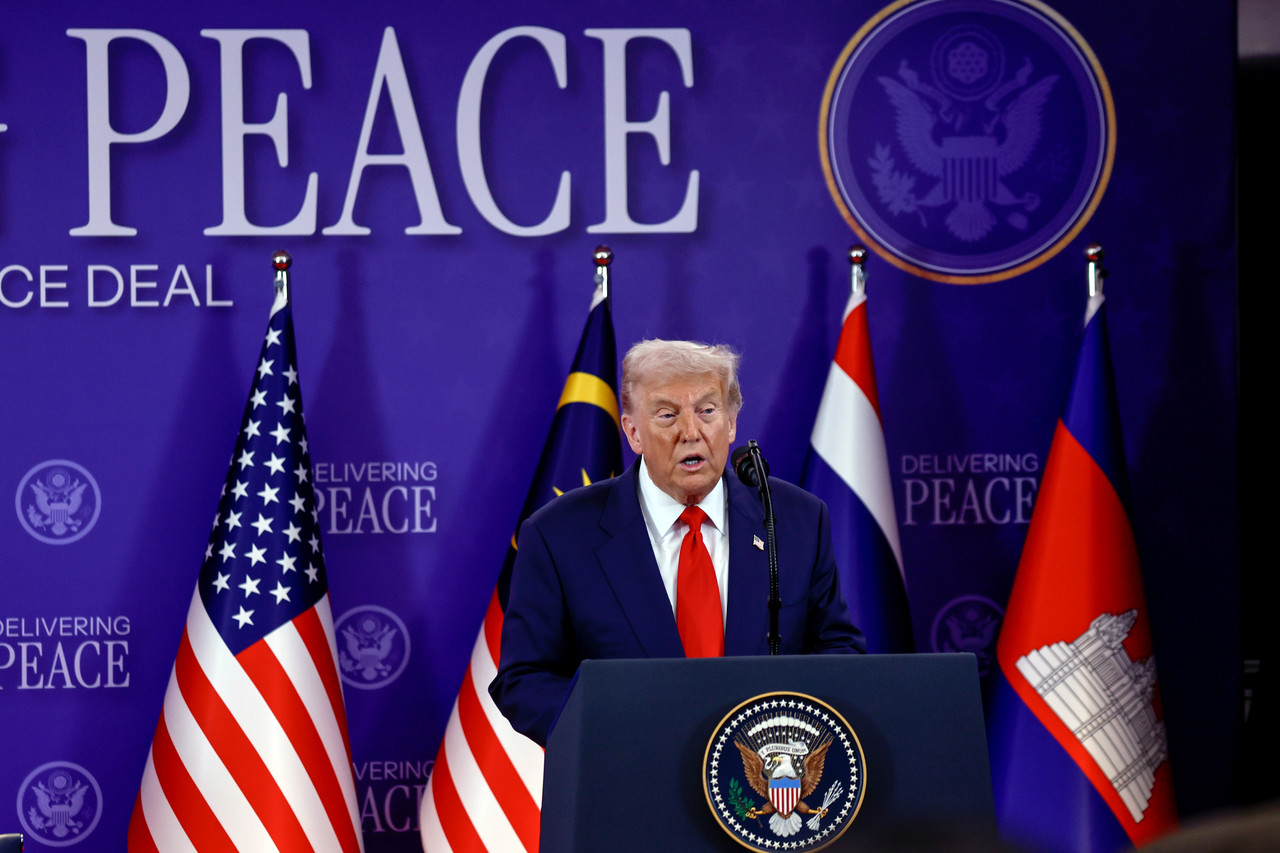
KUALA LUMPUR – The ruling by the United States (US) Supreme Court limiting President Donald Trump’s ability to unilaterally impose tariffs has lifted market sentiment globally. Economists believe the decision will positively affect Malaysia’s exports, capital markets, and currency outlook.
Dr Mohd Afzanizam Abdul Rashid, Chief Economist at Bank Muamalat Malaysia Bhd, told Bernama that the ruling signifies the effective separation of powers in the US, curbing potentially harmful economic policies. He noted that while the Trump administration may still attempt to enforce protectionist measures, the global economic risks have diminished somewhat, allowing for faster economic growth that could benefit an open economy like Malaysia.
“This would allow the global economy to grow at a much higher rate, which will benefit an open economy such as Malaysia,” he said, citing Malaysia’s unexpected 19.6% export growth in January 2026.
He further stated that global financial markets would likely welcome this news, which could improve Malaysia’s capital markets, including equities and bonds. The ringgit could also see further appreciation against the US dollar.
Legal clarity on tariff authority
Economist Dr Nungsari Ahmad Radhi explained that the Supreme Court ruling clarifies that tariffs are a form of tax and cannot be imposed unilaterally by Trump without Congressional approval. While the President can still seek tariff measures through legislation, such actions may face legal challenges and uncertainty.
“Anything imposed via executive orders will still be challenged, and this brings disrepute to whatever agreements are signed. The Supreme Court decision entails that all tariffs collected would need to be reimbursed,” Nungsari said.
On February 20, the Supreme Court struck down Trump’s tariffs imposed under the International Emergency Economic Powers Act (IEEPA), including his controversial reciprocal tariffs. In response, Trump announced a temporary 10% global tariff under Section 122 of the Trade Act of 1974, which is limited to 150 days.
Malaysia’s exporters keep watch
Mohd Sedek Jantan, Director of Investment Strategy at IPPFA Sdn Bhd, explained that the ruling does not change existing trade arrangements, but limits the legal basis for tariffs under IEEPA. He emphasized that Malaysian exporters should focus on monitoring the execution of policies, rather than expecting drastic changes in market access due to the ruling.
“The new 10% tariff is being framed as a temporary, economy-wide duty rather than a targeted penalty on specific countries or goods, which is important for Malaysia as its exporters are not singled out under the new framework,” he said.
The 10% tariff, being temporary, is not expected to significantly disrupt trade relationships or affect export volumes in the short term. However, businesses may face some cost uncertainties, primarily driven by sentiment rather than material changes.
Temporary tariff limits impact on competitiveness
Mohd Sedek added that the global tariff would not drastically affect Malaysia’s competitiveness, as the measure applies uniformly across all countries. He highlighted that Malaysia’s position in global value chains, particularly in electrical and electronics (E&E) and intermediate goods, should remain relatively stable.
He noted that the most likely effect would be short-term margin compression or pricing adjustments, rather than a shift in demand away from Malaysia. Malaysia’s diversified export base and integration into regional supply chains provide resilience.
In a recent report, Hong Leong Investment Bank Bhd stated that the temporary tariff creates a “lower tariff window,” potentially prompting US importers to frontload purchases. The 10% tariff is seen as a reduction from the earlier 19% reciprocal tariff, which could support near-term export momentum, particularly in electronics manufacturing services, gloves, and selected technology sectors.
US-Malaysia trade relations remain robust
Malaysia’s Investment, Trade, and Industry Minister Datuk Seri Johari Abdul Ghani confirmed that the government is reviewing the latest US legal developments. He noted that Malaysia would study the potential impact of the temporary tariff and monitor any adjustments.
“At this stage, we are awaiting further clarity on how these measures will be implemented and whether additional adjustments will follow,” Johari said in a statement.
Diplomatic engagement and regional coordination key
Dr Mohd Afzanizam stated that Malaysian officials would likely engage with their US counterparts to align policies, particularly regarding the Malaysia-US Agreement on Reciprocal Trade (ART), which has yet to be fully implemented. Malaysia’s diplomatic approach may present an opportunity to negotiate improved terms.
Meanwhile, Dr Anthony Dass, CEO of FSG Advisory Sdn Bhd, suggested that Malaysia should seek clarity on the tariff’s implementation and support exporters facing temporary margin compression. He also advocated for stronger regional coordination within ASEAN to maintain policy stability and bolster investor confidence.
“Malaysia may also strengthen operational credibility by enhancing rules-of-origin compliance, customs efficiency, and export documentation reliability,” Dass added. – February 21, 2026