

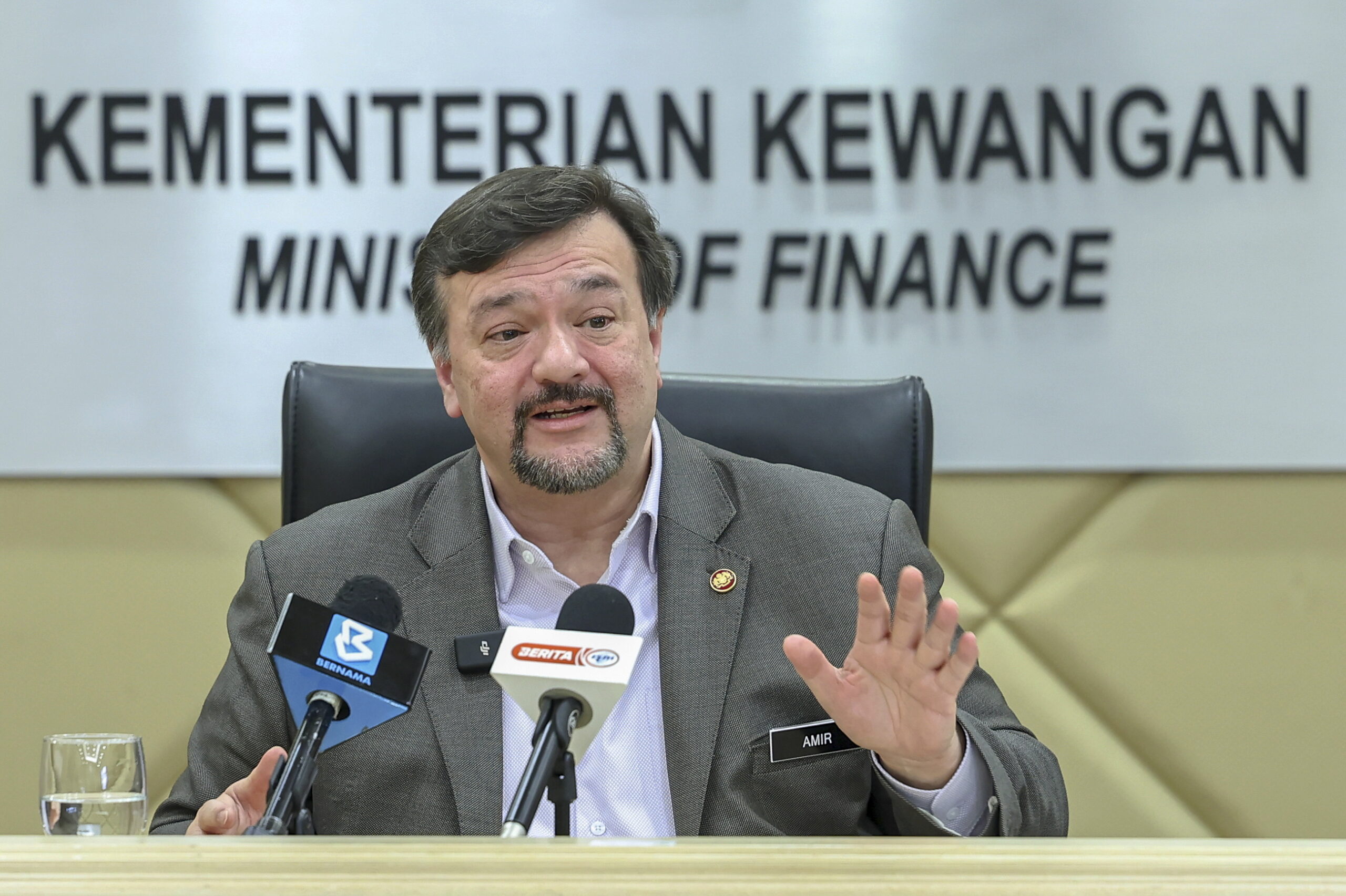
KUALA LUMPUR – The collaboration among Bank Negara Malaysia (BNM), government-linked companies (GLCs) and government-linked investment companies (GLICs) is seen as positive and has helped to strengthen the ringgit, said Finance Minister II Datuk Seri Amir Hamzah Azizan.
The move by BNM, along with the GLCs and GLICs, appears to have succeeded in encouraging continuous inflows into the foreign exchange market, he said.
“When GLCs and GLICs are enjoying better profits from foreign investments, they can repatriate some of these investment profits, and we encourage them to do so.
“We have seen the joint efforts of BNM, GLCs, and GLICs bearing fruit, and the ringgit has already strengthened over the last one and a half weeks,” he said during the debate session on the Motion of Thanks for the Royal Address in the Dewan Rakyat today.
Amir said that foreign investors’ confidence in Malaysia is increasing, which will further strengthen the national economy.
“Let the government continue with its current efforts. We welcome the increasing confidence of foreign investors to invest here and this will strengthen the country in the future,” he said.
As of March 8, the ringgit had risen against the greenback to RM4.68, he noted.
Meanwhile, Amir explained that the government has always managed the ringgit’s value by taking into account external uncertainties that are key factors for the currency’s movement.
He said this includes encouraging companies to prioritise domestic investments and repatriate their foreign earnings.
On the proposal to raise the statutory debt limit, he said the government has no intention of increasing the limit as its measures and commitment are to implement fiscal reforms to manage the deficit and debt level.
In fact, he said, the government is committed to reducing the debt level so it does not exceed 60% of gross domestic product (GDP) in the medium term, as targeted under the Public Finance and Fiscal Responsibility Act 2023.
Amir said the government’s new annual borrowings have started to show a downward trend post-Covid-19 pandemic following measures taken to reduce the deficit from 5.6% in 2022 to 5.0% of GDP in 2023 and further to the targeted 4.3% in 2024.
“In that regard, the government’s debt issuance amounted to RM230.9 billion in 2022 and RM226.6 billion in 2023. It is expected to be reduced further to RM207.5 billion in 2024,” he added. – March 11, 2024