

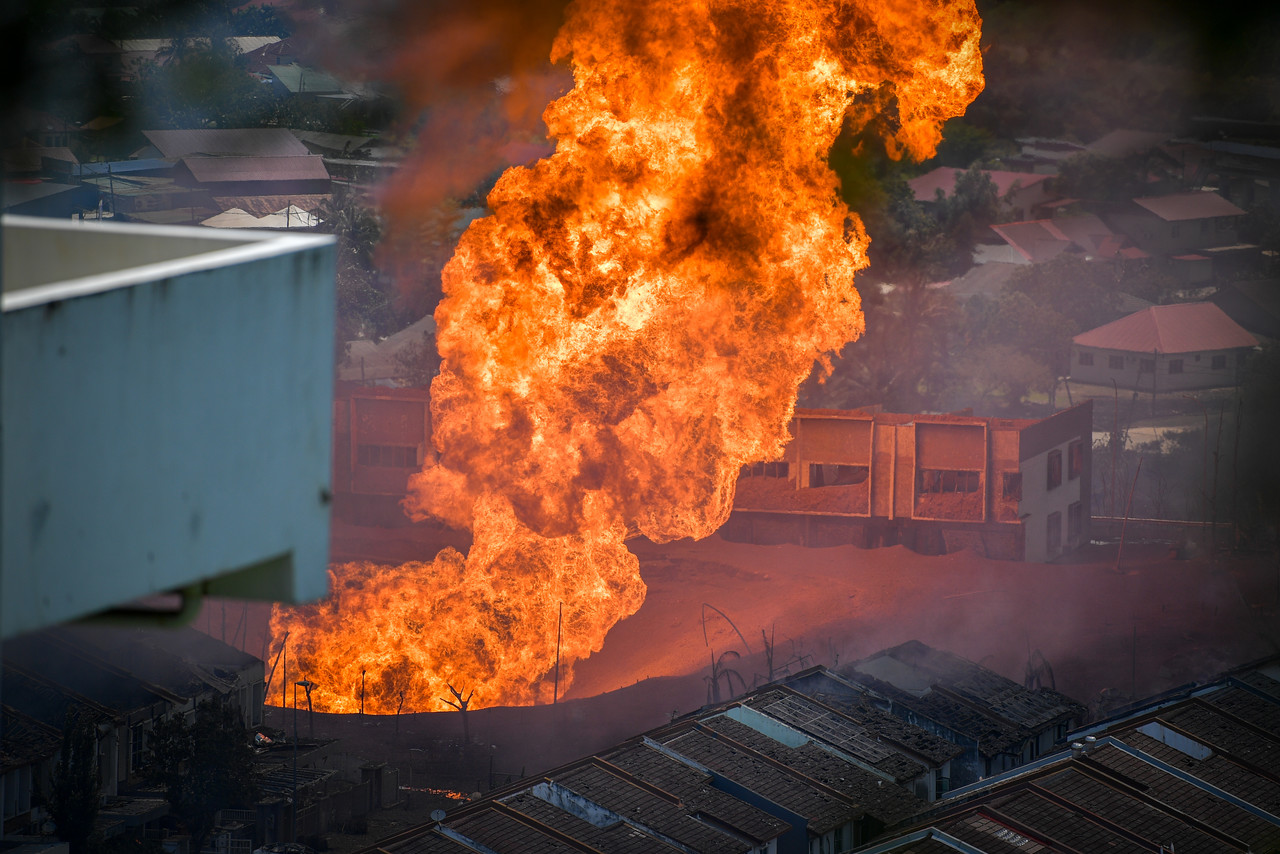

SHAH ALAM – Investigations into the gas pipeline explosion that occurred in Putra Heights on April 1 have ruled out elements of foul play, sabotage or negligence, according to Selangor Police Chief Datuk Hussein Omar Khan.
Speaking at a press conference on the investigation findings held at the Selangor State Secretariat Building (SUK) today, Hussein said a thorough probe was conducted with the involvement of multiple agencies, including the Department of Occupational Safety and Health (DOSH), Subang Jaya City Council (MBSJ), Petronas and other relevant authorities.
“The investigation covered all possible angles and involved two main aspects — potential sabotage under Section 435 of the Penal Code and elements of negligence under Sections 285 and 286 of the Penal Code. However, there was no evidence indicating these elements were the cause of the explosion,” he said.
He added that authorities had also scrutinised nearby construction works involving shop lots, sewer pipe replacement activities, and even the possibility of a bomb detonation or the burning of other materials.
“However, all of these were found not to be the cause of the incident,” he said.
The investigation, carried out jointly with forensic experts and technical agencies, ultimately concluded that the blast was due solely to technical factors.
Hussein explained that the site of failure was not due to surface-level activities, but instead stemmed from poor subsoil support beneath the ground.
He further noted that the gas leak and fire severely impacted public safety, damaged infrastructure, and disrupted gas and electricity supply in several areas.
“As a result, DOSH conducted a comprehensive investigation over nearly three months, working together with various other agencies,” he said.
Among the agencies involved were the Department of Minerals and Geoscience (JMG), Public Works Department (JKR), Fire and Rescue Department (JBPM), and the Royal Malaysia Police (PDRM).
The investigation was conducted under the Occupational Safety and Health Act 1994 (Amendment 2022) and the Petroleum (Safety Measures) Act 1984.
“The process involved visual inspection of the scene, measurement and assessment of pipeline components, and sample collection for laboratory analysis,” he added.
The underground gas pipeline explosion occurred at around 8.10am on April 1, affecting 529 residents from 118 households.
A total of 235 premises, including homes and shops, were impacted, with 87 units completely destroyed.
Additionally, 225 vehicles were damaged in the incident, which also left 126 individuals injured, some of whom required intensive care. – June 30, 2025