

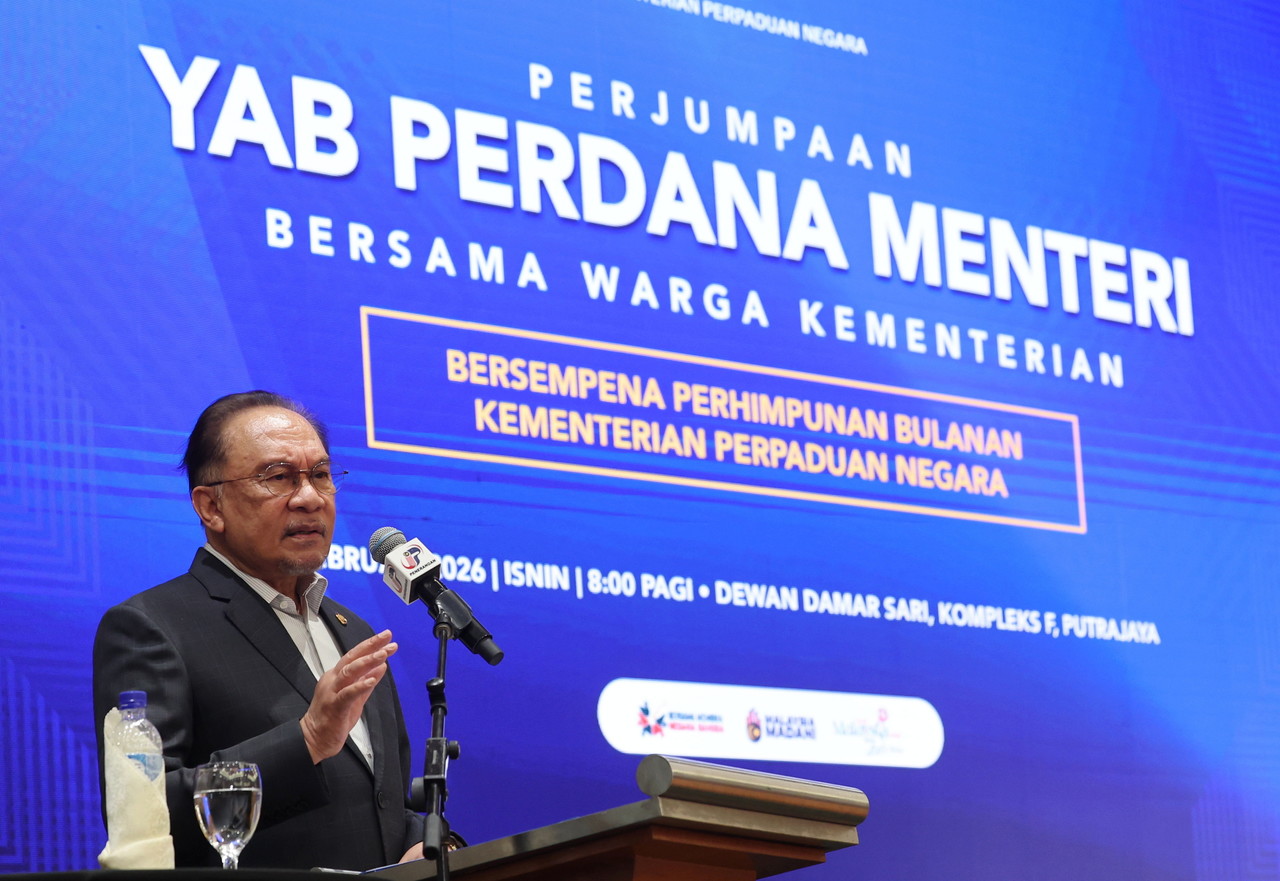
KUALA LUMPUR – The federal government has authorised local authorities (PBT) across the nation to take action against houses of worship, including temples, built on illegally occupied land.
Prime Minister Datuk Seri Anwar Ibrahim, speaking at the National Unity Ministry’s Citizens Meeting on Monday (February 9, 2026), acknowledged that the move might spark controversy. However, he defended the decision, asserting that it was grounded in the rule of law and was part of a policy that predated his administration, local media reported.
“I hereby want to announce our decision that we will no longer allow (encroachments) and that the municipal council (PBT) is given permission to ‘cleanse’ the unlawful temple,” he said.
Anwar emphasised that while the policy could invite controversy, adherence to the law was essential.
“This is the law of the country and it must be obeyed,” he added.
Despite the firm stance on enforcement, the Prime Minister stressed that authorities must act in a regulated and orderly manner, ensuring that ample time is given for compliance before taking action.
“What cannot be allowed is proliferation, growing everywhere, under trees, everywhere. This must be contained,” he said.
He also made it clear that enforcement actions should not be taken hastily or harshly if a structure is genuinely illegal. Those affected should be given reasonable time to resolve the issue, he said.
However, Anwar warned that delays in addressing such cases would not be tolerated. “If something takes up to a year to resolve, it is unacceptable,” he remarked, stressing the need for clear and efficient enforcement policies.
The Prime Minister reiterated that all houses of worship – including mosques, churches, and temples – are subject to the same legal framework, particularly regarding land ownership and planning approvals.
“If there is a violation, then we will take action. We follow the law, discuss in a legal and orderly way,” he stated.
Rejecting suggestions that the issue had only emerged under his leadership, Anwar pointed out that enforcement policies had been consistent throughout successive governments.
“The fact is, all previous governments, from Barisan Nasional (BN), Perikatan Nasional (PN), Pakatan Harapan (PH) until now, the government’s policies have continued,” he said.
While reaffirming the government’s commitment to religious harmony and fairness, Anwar stressed that legal violations could not be overlooked.
“Islam is the religion of the Federation, other religions are given their respective rights, but can we give permission to houses of worship that do not follow the rules?” he asked. “We cannot, because we follow the law.”
Anwar further questioned the legitimacy of worship conducted on land taken without consent, asking, “If it’s on someone else’s land, how can we worship by seizing someone else’s land?”
He firmly stated that land acquired illegally could not be legitimised, explaining, “Land that is illegal, forced, seized, or taken without permission cannot be made legal.”
As an example of lawful practice, Anwar pointed to Batu Caves, which had received proper approval, including for a proposed escalator to improve access for devotees.
“It does not disturb other people’s land, does not force, does not take away other people’s rights,” he said. The escalator project, he added, was conveyed to the Selangor Menteri Besar, ensuring that the Hindu community could continue their charitable efforts.
Anwar acknowledged that long-standing cases could be considered individually but cautioned against using age as a justification for continued non-compliance.
“If there is a case that has existed for 200 years, we will consider it as another case, but don’t use the excuse that it has existed for a long time to require approval,” he explained.
“If there were 1,000 temples that did not comply with the land permit and approval, wouldn’t they all want to be defended? It’s not possible,” he added. – January 9, 2026