

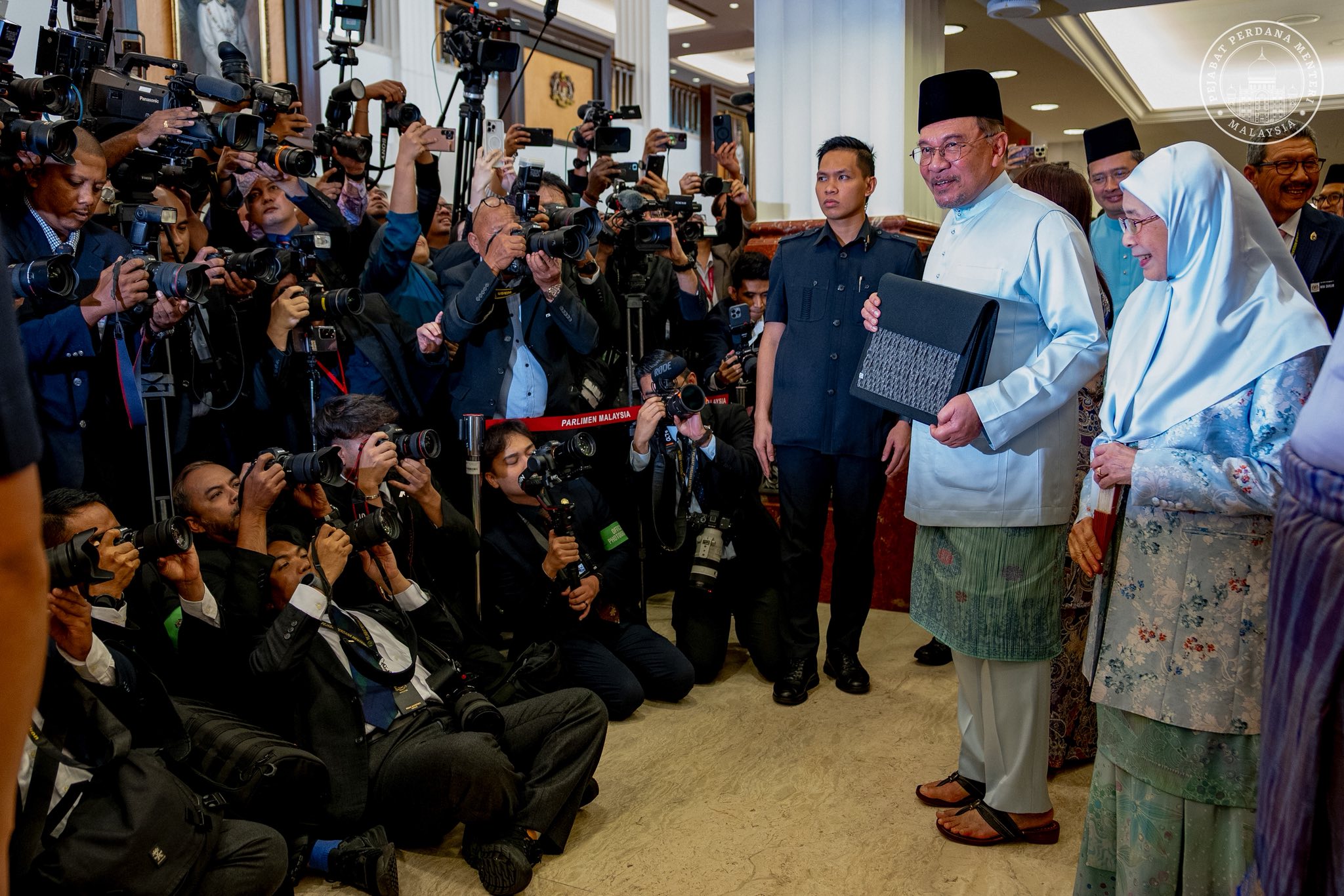

FROM his opening remarks, Prime Minister Datuk Seri Anwar Ibrahim cast Budget 2026 as a “Budget for the People,” continuing the Madani government’s narrative of inclusive growth under the 13th Malaysia Plan (13MP).
Given the timing (roughly a year before we go into general election mode) and the heavy tilt toward cash handouts, salary enhancements, and public sector benefits, one would not blame observers and critics to dub it an “election budget” — one designed to shore up support from key vote blocs (civil servants, retirees, low-income households) while maintaining the veneer of fiscal credibility.
But beyond pure politics, the design reveals a dual objective: injecting liquidity into domestic demand and buffering the consumption base, especially among vulnerable households. This helps stimulate growth in a somewhat fragile external environment.
Let’s unpack how Budget 2026 seeks to accomplish that.
Overall Size & Fiscal Anchors
The headline federal budget is pegged at RM470 billion for 2026.
Operating (recurrent) expenditure is projected at around RM338.2 billion, rising about 1.8 % over 2025 levels.
Development spending is boosted to RM81 billion, a modest increase (1.8 %) over prior years, reversing recent cuts.
The deficit is targeted to narrow to around 3.4 % of GDP.
In revenue projections, the federal government expects revenue of RM343.1 billion in 2025 (2.7 % growth), with careful calibration in 2026.
These macro anchors reveal the tension: the government is trying to be generous or at least generous-looking, while keeping a lid on fiscal deterioration.
One key lever is subsidy rationalisation: under Budget 2026, the subsidy allocation is slightly lower, reflecting savings from the newly implemented targeted petrol subsidy scheme (BUDI95).
This is a brilliant move in putting money into people’s pockets with immediate results: 300 litres allocation per Malaysian. And your receipt shows, as in a recent experience at the fuel pump – you fill RM101, you pay RM77.
It does not get more visceral than that.
By curbing blanket subsidies and shifting toward more targeted transfers, the government frees up fiscal headroom that can be redirected toward direct cash aids, civil service pay, or development projects.
Other examples of putting money in people’s pockets:
1. Special Aid for Civil Servants and Retirees
A signature move in this budget is the Special Aid (Bantuan Kewangan Khas, BKK):
Civil servants Grade 56 and below (including contract appointees) will receive a RM500 one-off aid, to be disbursed in early March 2026 ahead of Aidilfitri.
Government retirees (both pensioned and non-pensioned) will get RM250.
A portion of this is framed as part of the RM18 billion additional allocation toward the second phase of civil service remuneration adjustment (i.e. structural salary reform) starting Jan 2026.
This kind of cash bonus is politically potent: it directly increases disposable income for public servants and retirees, who are a large and concentrated demographic (and thus easier to mobilise in electoral terms).
2. Salary & Remuneration Reforms
* The Public Service Remuneration System (SSPA) enters Phase 2 starting January 2026 as part of a broader restructuring of civil service pay.
* Judges (a special category) will receive up to 30 % salary increases effective 1 January 2026 — their first pay revision since 2015. The opposition will have a lot to say about this, but judges are people too, with bills to pay and a retirement nest to build.
* To alleviate promotion bottlenecks, a Performance‑Based Incentive Scheme will be expanded to include management/professional groups. Officers with strong records but stalled for lack of vacancies may qualify for an incentive equivalent to one Annual Salary Increment (KGT).
These adjustments help not only by direct increments to pay, but by boosting morale, reducing turnover or brain drain, and stabilising income expectations for career civil servants.
3. Assistance Beyond the Civil Service
While the civil service gets headline attention, Budget 2026 also embeds support for low-income households, rural areas, and other vulnerable segments:
* Sumbangan Tunai Rahmah (STR) and Sumbangan Asas Rahmah (SARA) programmes are maintained as key social transfers.
* Various special one-off payments, including RM500 to about 70,000 religious educators and personnel (imams, KAFA teachers, mosque caretakers);
RM500 to military veterans under the Pingat Jasa Malaysia (about 120,000 recipients);
Increased Cost of Living Assistance (BSH) for 4,000 KEMAS contract retirees from RM300 to RM500/month.
Meanwhile, housing support has been extended to the Young Civil Servants Housing Financing Scheme (LPPSA), which benefits 48,000 civil servants under 30 years old.
The maximum loan eligibility under LPPSA has also been upped to RM1 million.
The budget allocates significant funds to repair and maintain government quarters, especially for front‑line civil servants (doctors, nurses, teachers, police, armed forces). RM2.2 billion is earmarked.
Sabah & Sarawak receive especially elevated allocations, reflecting the government’s push to narrow development gaps in time for the Sabah state elections.
In effect, these measures function as fiscal stimulus: they increase disposable income for lower to middle-income households, which tend to have a higher marginal propensity to consume.
4. Symbolic Acts & Solidarity Signals
Ministers and Cabinet members will maintain a 20 % salary cut – except Anwar, who does not draw a salary as Prime Minister and Finance Minister. Many scoff at this as it raises questions on how the PM is paying for stuff, but to Anwar, it is an effective statement of prudence.
As PM, he gets housing, transport, security and other perks. He still draws an allowance as a Member of Parliament. So he does not need the extra income – especially since his children are grown up and independent.
Various internal adjustments, modest as they are, help the government present a unified front of sacrifice and fairness, reinforcing the legitimacy of redistribution measures to the public.
Tomorrow: How Budget 2026 Seeks to Lubricate the Economy — October 11, 2025
Terence Fernandez is Editor in Chief of Big Boom Media which publishes Scoop