

KUALA LUMPUR – As Malaysia moves forward with the implementation of the Online Safety Act 2025 (ONSA), which includes restricting social media access for those under 16, experts say the age threshold may be more of a policy decision than a scientifically defined benchmark.
Clinical psychologist and family therapist Chiang Khai Chong, also known as K.C Chiang, said there is no specific age at which a person becomes “digitally ready,” noting that brain development is a gradual process rather than a fixed milestone.
“From science, I don’t think there is an age that is digitally ready. Because our brain develops gradually. So the answer is I don’t think there is one age that’s digitally ready,” she said on Scoop Insight podcast, hosted by Scoop’s Head of Podcast, Shazmin Shamsuddin.
Chiang explained that adolescence begins as early as 10 to 12 years old and continues well beyond legal adulthood, with full brain development only occurring in the mid-20s.
“So interestingly, from neuroscience, adolescence period starts at about 10, 11, 12,” she said, adding that generally, girls step into adolescence earlier than boys.
“And, yes, until which age is the end of adolescence? 24, 25. So it’s not 18,” she explained further, highlighting that the frontal lobe of the brain is fully developed at the age of 24 and 25.
Studies have also shown that younger adolescents, particularly those below 16, are more vulnerable due to ongoing brain development, especially in areas related to judgement, impulse control, and emotional regulation.
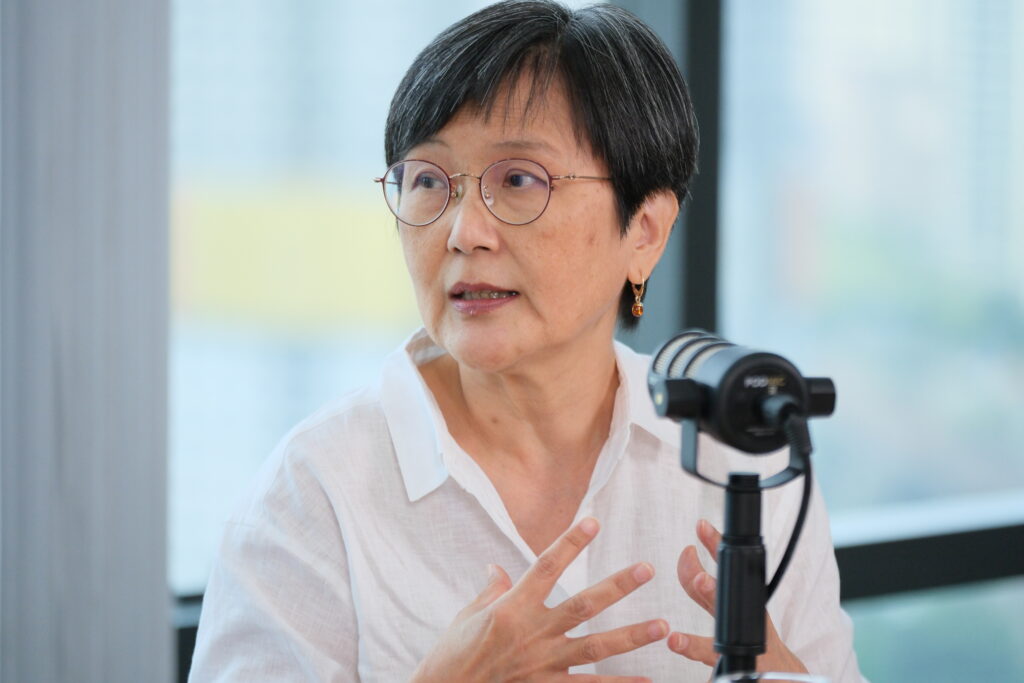
Chiang pointed to findings referenced in the World Happiness Report, which indicate that individuals aged between 11 and 15 fall within a more sensitive developmental phase.
“The study actually showed that adolescents at like 11, 12, 13, 14, like before 16, they are considered the vulnerable age, based on brain size,” she said.
However, she stressed that choosing 16 as a threshold does not mean individuals suddenly become fully equipped to navigate digital spaces.
“So then the question is why 16, not 25, right?” she asked, pointing out that from the age of 16, things kind of probably settle down a little bit because it’s moving towards integration.
Beyond biology, Chiang noted that psychosocial factors also play a role, as teenagers begin forming social identities and integrating into wider communities during this stage of life.
She added that delaying access to social media entirely may not be practical, as adolescence is also a critical period for social development and independence.
“And we can’t catch the children until they are ready because the adolescence years, they learn to integrate into the society, form their new community, prepare them to leave home.”
“So from 16 onwards, science says that it’s a little bit more subtle, so from 16 then you continue to grow,” she added.
The discussion highlights a broader debate surrounding ONSA’s under-16 restriction on whether it serves as a clear safeguard based on science, or a necessary compromise aimed at reducing risk in an increasingly complex digital environment. – April 12, 2026