

KUALA LUMPUR – The ongoing dispute over pig farming in Selangor could have been resolved through negotiations similar to those that ended the long-running durian orchard conflict in Pahang, according to former Selangor executive councillor Ronnie Liu.
Speaking in a recent Scoop Insight podcast, Liu argued that legal action should not be viewed solely as a confrontation but as a mechanism that could eventually lead to negotiations and a mutually beneficial settlement between farmers and the state government.
He cited the Royal Pahang Durian dispute as an example of how court proceedings can create opportunities for compromise.
“Once you start legal matters and legal actions and all that, there is always an opportunity for out-of-court settlement. But if you don’t take legal action, then you don’t have a chance of out-of-court settlement,” Liu said to podcast hosts, Scoop Editor-in-Chief Terence Fernandez and News Editor Azim Idris.
Liu, a former DAP politician, noted that the eventual resolution of the Pahang durian orchard issue benefited multiple parties through a negotiated arrangement in which the farmers can secure long-term rights to farm the land by sub-leasing from the state government and selling their produce to a designated company.
“Royal Pahang (Durian Export Sdn Bhd) as a company, gets the fruits to sell, (and) make some profits. And the state government gets the rent, land tax and all that. And then the federal government gets the income tax, corporate tax, that kind of thing. So it’s a win-win situation,” Liu said.
He said a similar approach could still be adopted for pig farmers affected by the Selangor’s decision to phase out farming operations in Tanjong Sepat, adding that discussions on relocation, compensation and restructuring could have taken place if all parties were willing to engage.
His previous criticism of Selangor’s decision to end large-scale pig farming sparked strong reactions after some interpreted his remarks as disrespect for Sultan Sharafuddin Idris Shah, and thus the monarchy.
The Sultan subsequently stressed that the ban on pig farming in the state was necessary to protect public health and the environment.
However, Liu maintained that any proposed legal action by pig farmers would be against the state government, rather than the palace.
The former exco member also noted that the roots of the pig farming controversy predated the current administration.
Plans to modernise pig farming in Selangor were first explored under the Barisan Nasional state government led by former Menteri Besar Datuk Seri Dr Mohamad Khir Toyo, prior to the “political tsunami” in 2008.
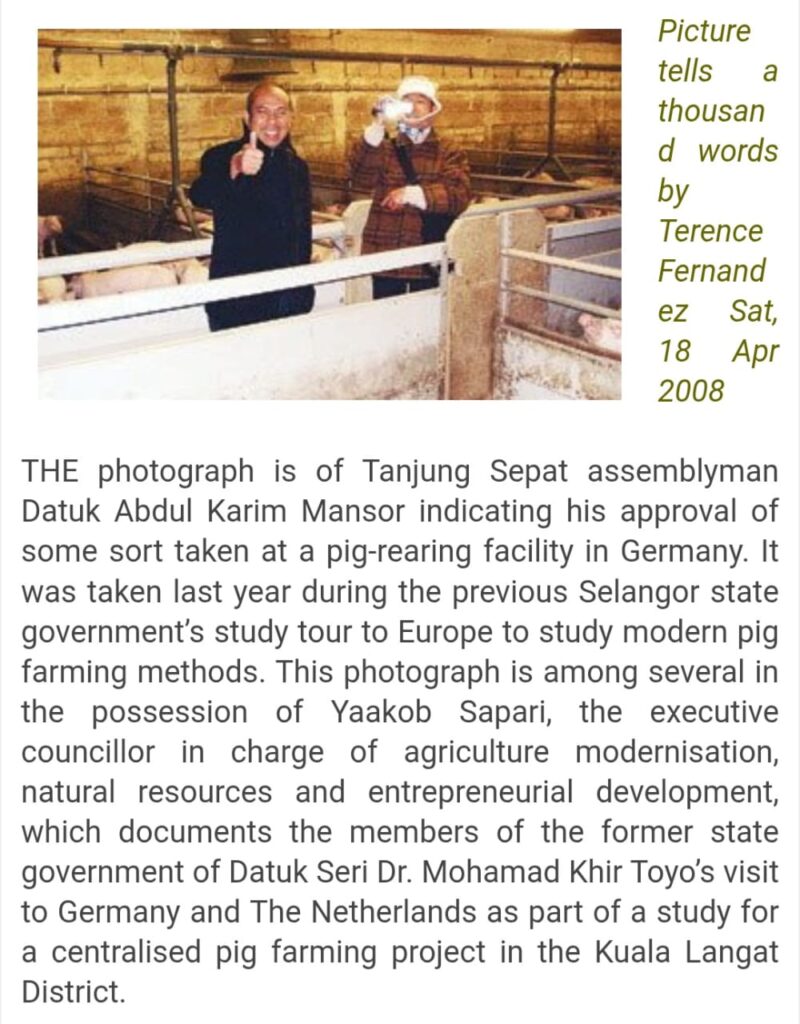
Fernandez, who reported on the matter that year, revealed that then-Tanjung Sepat assemblyman Datuk Abdul Karim Mansor had participated in an official study trip to Germany and the Netherlands to examine modern pig farming methods.
The Selangor delegation later proposed a modern pig farming project to the state government before the political transition.
Fernandez reported that photographs from the visit showed Abdul Karim visiting pig farming facilities and endorsing proposals for a centralised pig farming project in Kuala Langat.
The article also noted that documents related to the study trip had initially been classified as official secrets by the previous state administration before being declassified later.
In response, Liu said the Pakatan Rakyat administration had continued exploration of the modernisation proposal.
“I remember very well that when the late Tan Sri Khalid Ibrahim was alerted about this issue, he brought the matter up in the state exco.”
“We then gave Ean Yong Hian Wah, who was handling the Chinese new village portfolio, the task of exploring the possibility and viability of modern pig farming in Tanjung Sepat.”
However, he said the proposal eventually stalled due to financial constraints, as it required significant funding that pig farmers could not afford.
Liu stressed that even at the time the farms were operating without any major issue, which meant that the farms were clean and there were no complaints of bad smells and pollution.
“So this controversy that came about is a bit unusual,” he added.
Liu claimed the current dispute only escalated last year when farmers were informed that they would have to comply with additional requirements to continue operating.
“So they list out certain things for them that they must improve and all that. And then they did try to improve, but no follow-up. Then suddenly, they were verbally told that you guys cannot do (pig farming) any more,” he said.
According to Liu, farmers subsequently sought meetings with state leaders in an effort to find a solution before the matter became public.
“Then after that, the news broke, the farmers did a peaceful rally, and the state government said that they will look into it.”
However, Liu said the state government had yet to fully explore alternative solutions, including relocation options, insisting that farmers had never ruled out moving if a viable plan was offered.
The pig farming issue remains one of Selangor’s most contentious policy debates, with affected farmers continuing to weigh legal action, while the state government proceeds with plans to close farms in Tanjung Sepat.
Despite ongoing criticism from affected parties, the Selangor government indicated the process of clearing pig farms is now in its final stage, with about 11,000 pigs still remaining across roughly 30 operational farms.
Selangor Infrastructure and Agriculture Exco Datuk Izham Hashim said the farms are being closed in stages after an enforcement order issued in February, but the process is delayed because many of the animals have not yet reached suitable weight and maturity for slaughter.
He added that no new piglets are being introduced, and all remaining pigs will be sent to the Rawang slaughterhouse once ready.
The phased approach is meant to ensure an orderly shutdown while managing animal welfare and logistics, with authorities expecting the process to be completed soon.
The state government had earlier decided to stop issuing pig farming licences and phase out existing operations following policy changes linked to environmental concerns and the Sultan of Selangor’s stance on pig farming.
Meanwhile, farmers are being guided through a transition process, including relocation and possible shifts into other agricultural activities. – June 8, 2026