

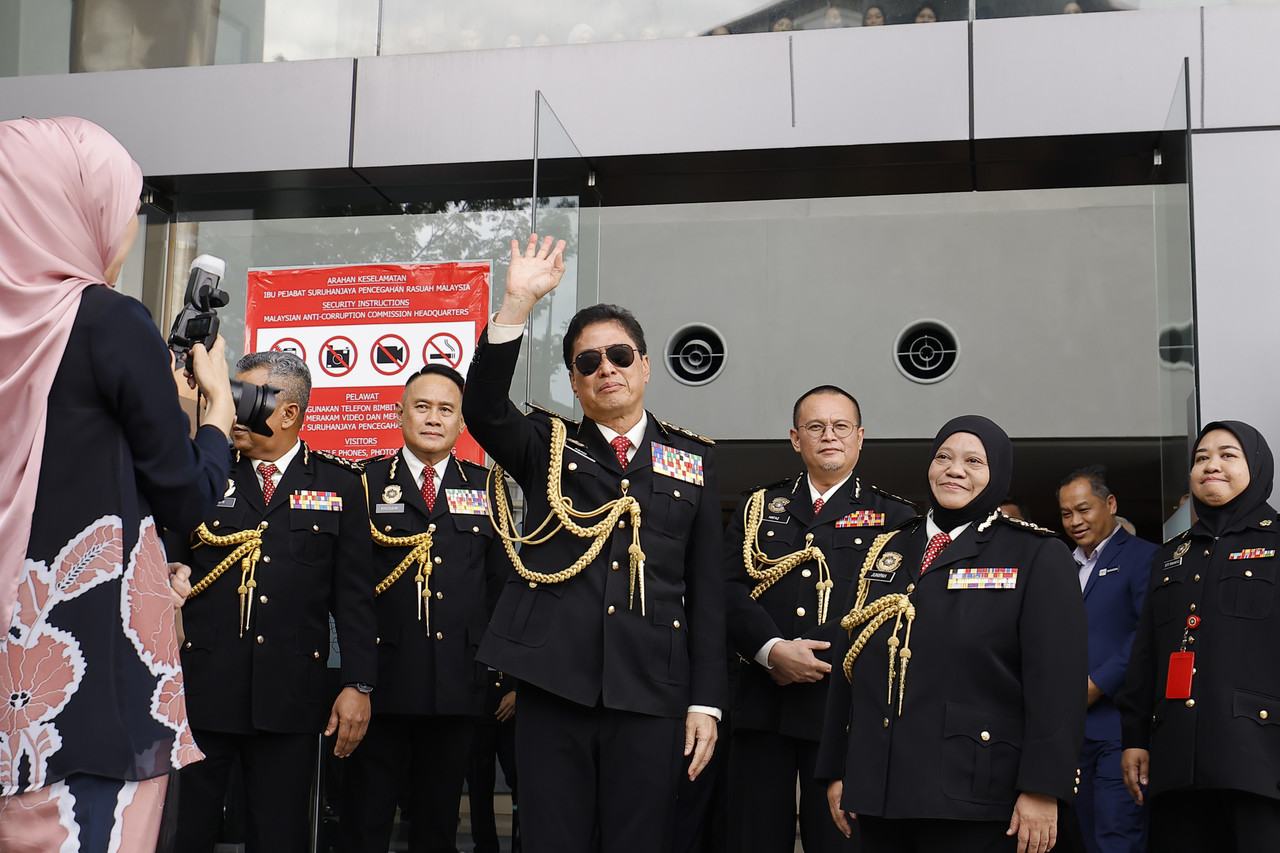
RARELY have I met someone as courageous and honourable as Tan Sri Azam Baki.
Some people shine too brightly, and in doing so, inevitably attract resistance. That has been the story of Azam Baki.
He shines in his courage, his sharp intelligence, his uncompromising anger towards corruption, and also in the rawness and authenticity of who he is as a person.
Those who have truly met and worked with him know this. Once you know him beyond the headlines, it becomes difficult to reconcile the public caricature with the man himself.
Working with the Malaysian Anti-Corruption Commission (MACC) has been one of the greatest learning experiences of my life, and also one of the most difficult. As someone who came from almost three decades in journalism and media – advocating for refugees, indigenous communities, environmental causes, and the vulnerable – stepping into the world of enforcement was both humbling and deeply enlightening.
Many of my liberal friends jokingly called it “joining the dark side.” But being inside the system taught me something uncomfortable: real governance and reform are often far messier, slower, and harder than public narratives allow.
Perhaps the most painful realisation for me was not the existence of corruption itself, but the failure of media, politics, and democracy to consistently educate and elevate society. The freedoms we cherish can also be manipulated for partisan interests, sensationalism, and manufactured outrage. In that noise, truth is often sacrificed.
Those reporters who have closely followed MACC operations under Azam Baki know the scale and intensity of the work done over the past six years.
Never in our history has anti-corruption enforcement been this aggressive and far-reaching. Individuals and institutions once considered untouchable were investigated and brought down one by one, from plastic and e-waste syndicates, to senior government officials, politicians, even the Panglima Tentera entrusted to defend the country, corporate
figures with Tun and Tan Sri titles, those hiding behind religious labels while abusing zakat funds and those exploiting public sympathies for Gaza.
The international asset recovery efforts linked to the 1MDB scandal alone stand as one of the most significant enforcement achievements in modern Malaysian history. With fewer than 3,000 officers compared to 150,000 personnel in the police force, MACC’s impact has been extraordinary.
But such high-profile enforcement inevitably creates powerful enemies.
The wealthy and influential who are beig investigated have access to media machinery, political networks, foreign PR consultants, and coordinated narratives capable of creating confusion over who the real villains are. In today’s media environment, perception creates reality rather than dry facts.
Politicians can speak daily, dominate headlines, go live on TikTok, Podcast themselves to death and continuously shape public opinion by portraying themselves as victims rightly or wrongly. Civil servants cannot do the same. Enforcement agencies operate within legal and institutional boundaries. They cannot publicly fight every accusation or counter every narrative in real time.
And so, much of the silence is interpreted as guilt. And when it is explained, it is seen as defensiveness.
In many ways, Azam Baki may be one of the most misunderstood public servants in the country. Internationally, MACC’s work under his leadership is respected. Foreign anti-corruption agencies come to Malaysia to study aspects of our enforcement and asset recovery strategies. Yet domestically, his name has often been relentlessly attacked and politicised, despite no criminal wrongdoing ever being proven against him.
As for me, I stand by the truth, and I stand by him unless credible evidence proves otherwise.
Today marks Tan Sri Azam Baki’s final day as Chief Commissioner of MACC after six years leading one of the country’s most difficult institutions.
History will ultimately judge every public figure fairly with time. But regardless of differing opinions, no one can deny that his tenure fundamentally changed the scale, boldness, and direction of anti-corruption enforcement in Malaysia.
I have also undertaken a personal mission, to one day write the untold story of 1MDB from the perspective of enforcement officers and civil servants whose sacrifices, pressures, risks, and realities are often absent from public discourse.
Because history is not only shaped by politicians and headlines. Sometimes, it is also carried quietly by the officers who fought in the shadows. – May 12, 2026
Jules Ong is the Deputy Director of the Strategic Communications Division at the Malaysian Anti-Corruption Commission (MACC).