


KUALA LUMPUR – Bus Rapid Transit (BRT) has emerged as the cheapest and fastest short-term solution to ease congestion in Johor Bahru, as rail experts warn that longer-term systems like Autonomous Rail Transit (ART) must still be carefully planned to meet future demand.
They stressed that while the proposed ART system remains a key component of the city’s transport plans, immediate pressure from the upcoming Johor Bahru–Singapore RTS Link requires practical and quickly deployable alternatives.
A tight timeline has been set for the ART rollout, which is targeted for completion by 2027, but experts cautioned that a more holistic and phased approach is needed to ensure sustainability and efficiency.
Speaking during a Scoop Insight podcast hosted by Big Boom Media Group Editor-in-Chief Terence Fernandez, Datuk Dr Mohd Yusoff Sulaiman, President of Malaysia Rail Industry Corporation (MARIC) Rail, said Johor Bahru should be “scared” about the opening of the RTS Link next January.
“We are still talking about planning and choosing systems, but January is just around the corner,” he said. “We need to be prepared to handle 10,000 passengers per hour through Bukit Cagar.”
Yusoff added that while ART may offer faster deployment compared to traditional rail, it “must be scalable and future-proof.”
“If it is going to operate on the ground, it is limited by what is on the road,” he said.
“The best approach is to elevate it on a viaduct so it can later be upgraded to a light rail transit system. Starting elevated allows for both short-term deployment and long-term scalability.”
He questioned the wisdom of committing to a system not widely used globally.
“As a member of the public, I would ask: why choose a system that is not widely adopted around the world?” Yusoff said.
Capacity was another concern.
“ART can carry 5,000 to 6,000 passengers per hour. An automatic people mover (APM) and BRT can carry up to 12,000. LRT can go up to 20,000,” he said. “Incremental growth must be planned.”
Yusoff also highlighted the need for adaptable solutions.
“Every city is different – geography, population growth, land use,” he said. “We should not just put cities into boxes labelled LRT, MRT, or ART. Whatever we build today must be adaptable for future upgrades.”
He also called for strengthening Malaysia’s rail ecosystem.
“If you can design and build your trains, you can adapt them,” he said. “Government support is critical. It cannot be left to companies alone.”
As Johor Bahru prepares for a surge in cross-border movement once the RTS begins operations, Yusoff said urgency must not override strategic planning.
“Finance is also a key issue,” he said. “We need new financial models, not just government funding. And we need coordination – a strong authority to make integrated decisions. Johor Bahru must act quickly, but wisely. Whatever system is implemented today should not become tomorrow’s bottleneck.”
Datuk Seri Dr Shahril Mokhtar, Executive Director of Destini Bhd and former CEO of Mass Rapid Transit Corporation (MRT) Corp, said ART could serve as a short-term solution.
“ART may provide a faster deployment,” he said. “But in the long term, the viable solution for Johor Bahru is LRT.”
He added that temporary measures like BRT lanes could provide immediate relief.
“Dedicated bus rapid transit lanes could be implemented within eight to ten months to ease congestion once RTS operations begin,” he said. “It’s the cheapest short-term solution and can integrate with ART or future LRT upgrades.”
Reports from around the world show that BRT systems are widely used as cost‑effective urban transport solutions in cities like Bogotá in Colombia, Jakarta in Indonesia and Guangzhou in China.
Studies indicate that implementing BRT corridors can cost anywhere from around USD 1 million to over USD 15 million per kilometre — significantly lower than light rail or metro systems, which often exceed tens of millions per kilometre.
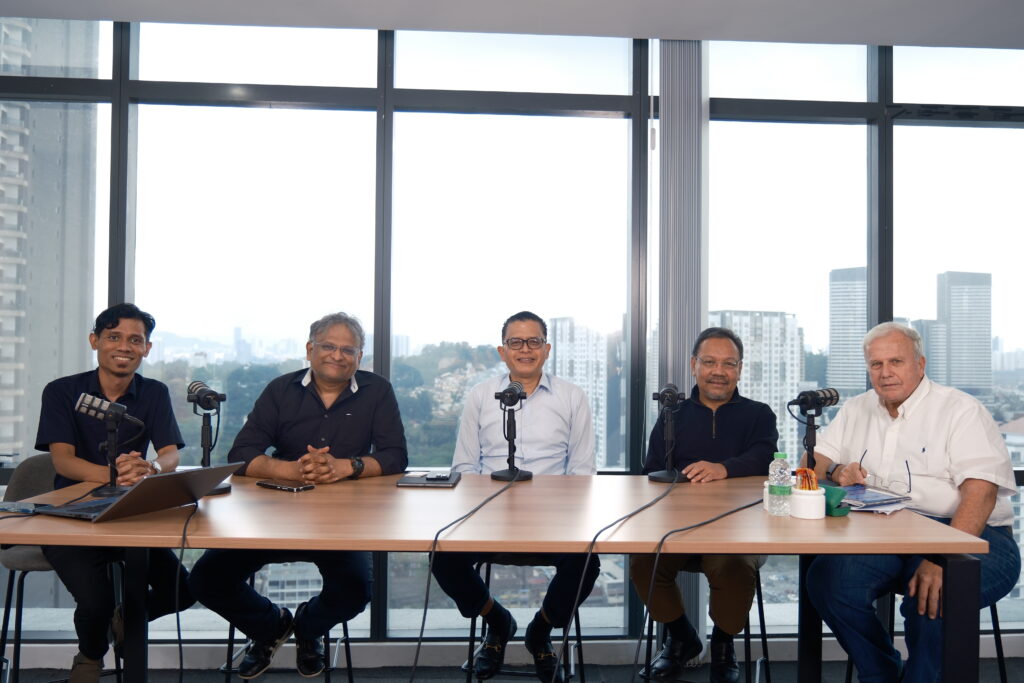
Malcolm G. Owens, international railway expert and advisor, cautioned against mixing ART with existing traffic.
“Johor Bahru’s roads are already congested,” he said. “Mixing ART with heavy lorries, motorcycles, and increasing private vehicles is quite unnerving. You are committing road space permanently.”
He also highlighted concerns about sourcing and system capacity.
“Most ART trains, like those supplied by CRRC, are suitable for lower-density corridors,” Owens said.
“If ridership grows quickly, these trains may not suffice. You can’t just add more carriages without structural adjustments.”
Owens stressed the importance of building local capability.
“Malaysia should not rely entirely on imported systems,” he said. “Investing in local rolling stock production ensures we can adapt trains to our needs and maintain them sustainably. It avoids future bottlenecks and dependency.”
He compared ART to other systems globally.
“An ART is a hybrid between a bus and a tram, carrying around 120 passengers per carriage. Automatic people movers (APM) can hold up to 270, and an LRT can go much higher. We must plan for incremental growth from day one,” he said.
Owens also cited Singapore’s Bukit Panjang LRT as a proven model.
“It is a rubber-tyred automatic people mover, very quiet and reliable. Short-term BRT solutions or APMs can complement ART to ease congestion immediately while commuters get used to the system,” he said.
The Johor Bahru ART project is part of the city’s broader 2035 Transport Master Plan, aimed at easing chronic traffic congestion and improving cross-border connectivity with Singapore ahead of the RTS Link opening.
Authorities are prioritising high-traffic alignments such as Tebrau, Skudai, and Iskandar Puteri to help disperse passengers and reduce bottlenecks once RTS operations begin.
The project carries an estimated budget of RM7 billion—significantly lower than a conventional LRT—and is scheduled for completion by 2027.
The proposed elevated ART line will feature roughly 32 stations over more than 50 km, linking key residential, commercial, and industrial corridors.
Authorities say the system is intended as a flexible, scalable solution that could be upgraded to a full LRT network if commuter demand increases, complementing the RTS Link and easing congestion on major thoroughfares. – April 2, 2026