

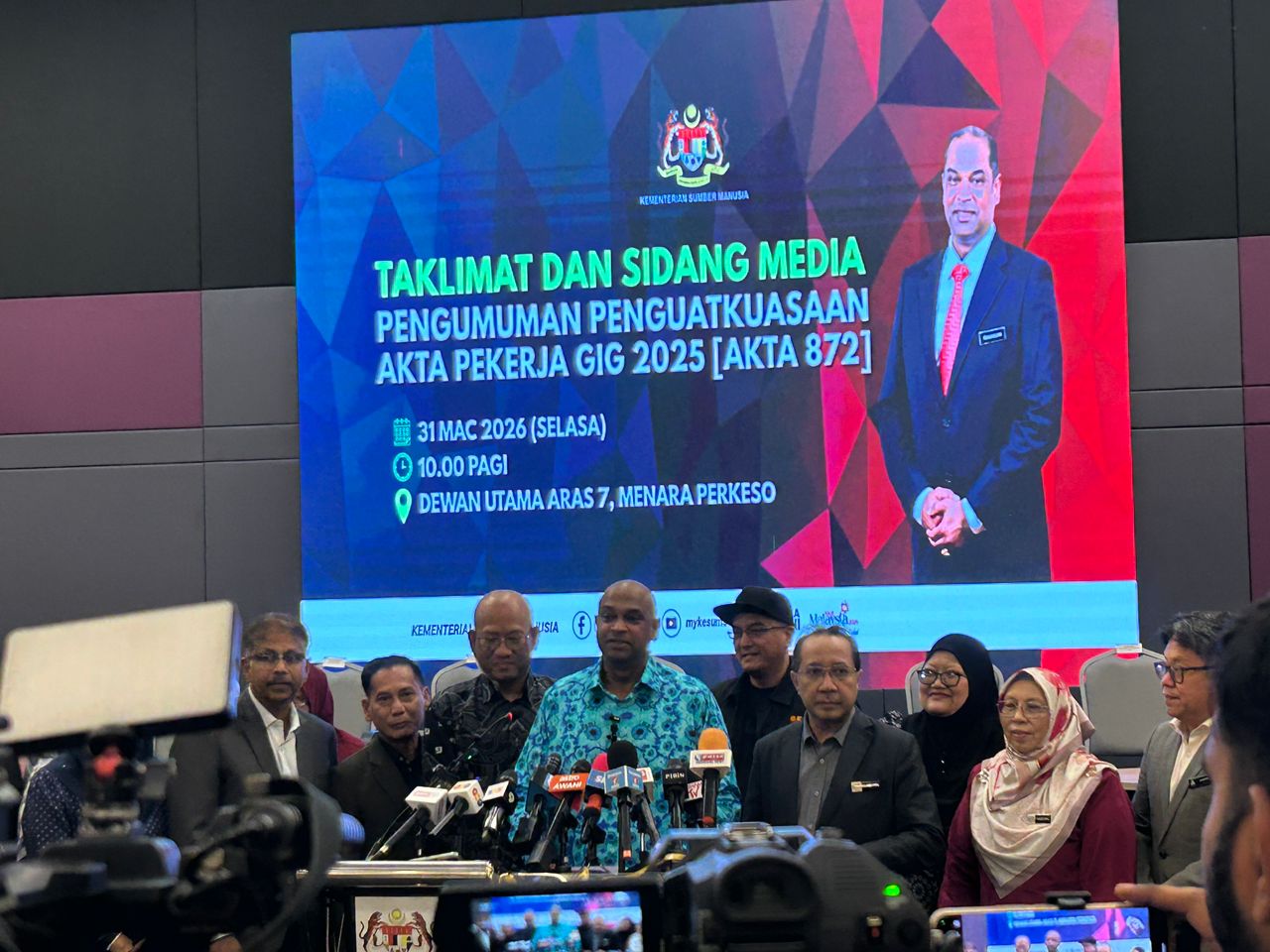
KUALA LUMPUR – The Human Resources Ministry (Kesuma) has officially enacted the Gig Workers Act 2025 nationwide, establishing a formal legal framework for the country’s growing gig economy.
Effective immediately, the legislation introduces a comprehensive structure designed to protect local gig workers, with benefits strictly limited to citizens and permanent residents.
Addressing concerns that the law was rushed, Human Resources Minister Datuk Seri Ramanan Ramakrishnan emphasised the extensive preparation.
“The drafting of Act 872 began in 2024. Before it was passed in Parliament, KESUMA conducted 37 engagement sessions involving 3,873 participants… Therefore, the issue of this act being rushed does not arise.”
A key feature of the Act tackles long-standing problems with arbitrary account suspensions. Platform providers are now prohibited from deactivating a worker’s account for internal investigations of misconduct for more than 14 days.
Workers whose accounts are deactivated due to alleged misconduct will receive 50% of their estimated lost income for the suspension period. Serious criminal matters, such as harassment, remain subject to full investigation under existing Penal Codes and national statutes.
Financial security and social protection are also enhanced through a mandatory 1.25% contribution from each task’s base earnings into PERKESO. Tips and incentives remain fully protected.
To facilitate complaints, KESUMA will launch a dedicated portal on 1 April 2026.
“Under our ‘No Wrong Door Policy,’ gig workers may also visit any Department or Agency under the Human Resources Ministry to lodge a complaint,” the Minister said, highlighting the accessibility of these new channels.
Disputes can also be resolved via mediation or the newly established Gig Workers Tribunal, providing a faster and more affordable alternative to civil courts.
Industry leaders have welcomed the legislation as a crucial step in safeguarding gig workers’ dignity.
“The Workers Act has been enacted 20 times since its implementation. So please allow it, don’t block it,” urged Nathan Mathivanan, President of the Land Public Transport Transformation Association (TPAD).
“This Act provides a very important safety net for e-hailing drivers. The 1.25% contribution is a small price to pay for the long-term social protection we are getting,” said Azrani Rustam, Head of Public Policy at Bolt. He added that stakeholders look forward to the first Gig Consultative Council (MPGig) meeting to address income rates.
Similarly, Khalil Saleh, President of the Professional Film Workers Association of Malaysia (Profima), expressed relief at the sector’s formal recognition.
“We’ve been waiting for this for a long time. Now that it’s official, I hope the industry will become more organised, especially in terms of payments and the safety of our workers.”
Attention now turns to the inaugural MPGig meeting on 3 April 2026, where members will begin standardising income rates for gig workers. – March 31, 2026